

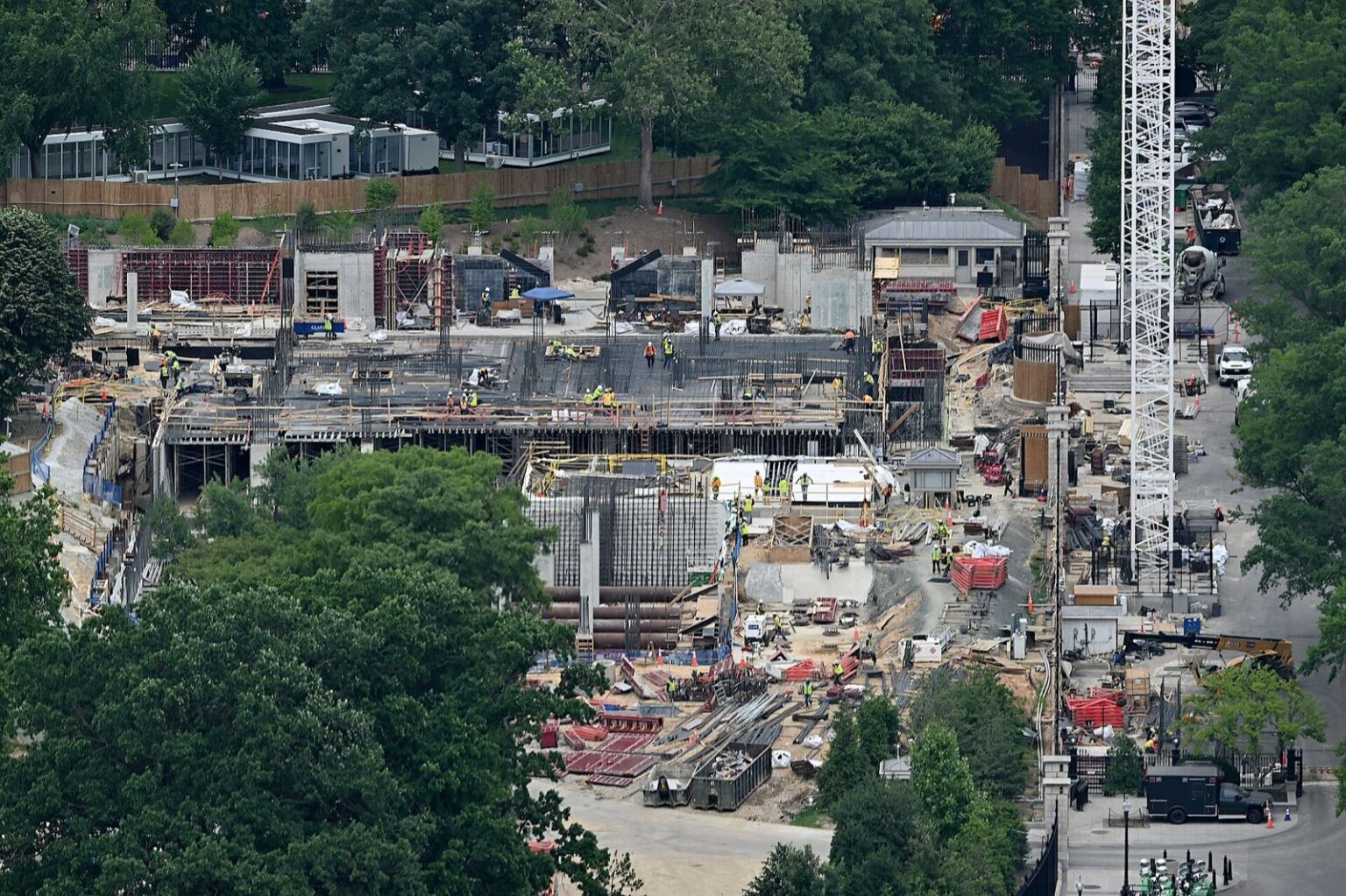
The U.S. Supreme Court has given the green light to the construction of the new White House ballroom, a 400-million-dollar project that has for months divided judges, conservationists, and the Trump administration itself. With a 5–4 vote, the justices blocked the order of a lower federal court that had imposed a halt to the work, clearing the way for the completion of a building that will replace the East Wing, demolished last year on the president’s orders.
Key points
- The Supreme Court voted 5–4 to allow work on the White House ballroom to continue.
- The project costs 400 million dollars and will replace the East Wing, demolished in 2025 at Trump’s behest.
- Chief Justice John Roberts voted against the majority, calling the construction likely unlawful.
- The lawsuit had been brought by the National Trust for Historic Preservation, but the Court questioned its standing to sue.
- The construction sites operate twenty hours a day and the structure is expected to be completed by the summer of 2028.
The Supreme Court approves construction of the White House ballroom
The decision, handed down on Monday, overturns an order issued by a district court and upheld by a federal appeals court, which had halted the work pending the outcome of the lawsuit brought by the National Trust. The Trump administration had requested emergency intervention from the Supreme Court after that ruling, arguing that the project could not remain on hold.
A 5–4 split vote and Roberts’s dissent
The majority of five justices signed an order not individually signed, while Chief Justice John Roberts sided with the Court’s three liberal members against the resumption of work. In his dissent, Roberts wrote that “the President ordered the demolition of the East Wing of the White House to make room for a new privately funded reception hall” and that “that construction is likely unlawful.” The Chief Justice recalled that Congress has expressly prohibited the construction of buildings on federal land without its “explicit authorization,” and that the ballroom is located precisely on public land, President’s Park, without Congress ever having granted that go-ahead. The previous week, it was Roberts himself who had granted a temporary stay of the lower court’s order, giving the full Court time to consider a broader extension.
Project details: costs, size, and timeline
The project calls for a structure of about 90,000 square feet, intended to replace the east wing of the White House that was torn down in 2025. The total estimated cost is about 400 million dollars, a figure that makes this the most extensive renovation of the presidential residence in recent decades.
Construction crews working twenty hours a day toward 2028
On the operational front, work crews are moving ahead at an intense pace, with shifts of up to twenty hours a day. The stated goal is to deliver the project by the summer of 2028. It is precisely this acceleration of the work that lies at the heart of critics’ concerns: before the legal dispute returns to the Supreme Court, it is likely that construction will already have reached a very advanced stage, effectively making any future judicial decision irreversible.
The National Trust lawsuit and the question of standing
At the heart of the matter is the lawsuit filed by the National Trust for Historic Preservation, the U.S. organization dedicated to protecting historic heritage, which asked to block the project, arguing that it lacked congressional approval. The Supreme Court, however, did not address the merits of the project’s legality: it limited itself to raising doubts about the association’s standing to sue.
Why the Court did not rule on legality
In the order, the majority deemed likely insufficient the statement by Alison Hoagland, a member of the National Trust, who said that having to look at the completed ballroom during her visits to the neighborhood would cause her “harm.” The justices wrote that “mere annoyance, disagreement, or aesthetic aversion do not constitute a concrete and particularized injury” under the Constitution, adding that “almost every government action or project can offend someone’s sensibilities.” Roberts countered that “the White House is an iconic American building whose symbolism and history are intertwined with its architecture” and that a member of a historic preservation association “can be concretely and particularly harmed by the transformation of a historic building that they regularly visit.” The case will now return to the lower courts, with the possibility that it will once again reach the Supreme Court at a later stage of the dispute.
The national security argument and political reactions
Among the reasons cited by the majority justices is the argument advanced by the Trump administration that the ballroom is necessary for reasons of national security, as it would protect an underground military installation not yet built and provide safer cover than the tents used so far for large events at the White House.
Trump welcomed the ruling enthusiastically on Truth Social, writing that “we are living in the Golden Age of America, and this building will be one of the greatest ever built in Washington,” and that, once completed in the summer of 2028, “the magnificent ballroom and military complex will be something the entire country will be very proud of.” The president added that the project, “despite the baseless lawsuit brought by the so-called National Trust for Historic Preservation, which is in no way affiliated with the government of the United States, is under budget and ahead of schedule.”
FAQ
Why did the Supreme Court allow work on the ballroom to continue?
The Court voted 5–4, basing its decision mainly on doubts about the National Trust for Historic Preservation’s standing to sue, without ruling on the legality of the project.
What are the reasons for opposition to the ballroom project?
The National Trust argues that the project lacks congressional approval and violates historic preservation rules.
What justification did the Trump administration give for building the ballroom?
The administration stated that the ballroom is necessary for national security reasons, to protect an underground military installation.
When is the White House ballroom expected to be completed?
Work is underway with crews active twenty hours a day, and the structure is expected to be completed by the summer of 2028.
Read also: Palazzo Strozzi opens the exhibition on fragmented art: 80 works, 4,500 years · Stuart Semple lawsuit: court orders him to pay 16,000 euros over Klein blue
Content produced with the assistance of artificial intelligence and with human editorial review.


