

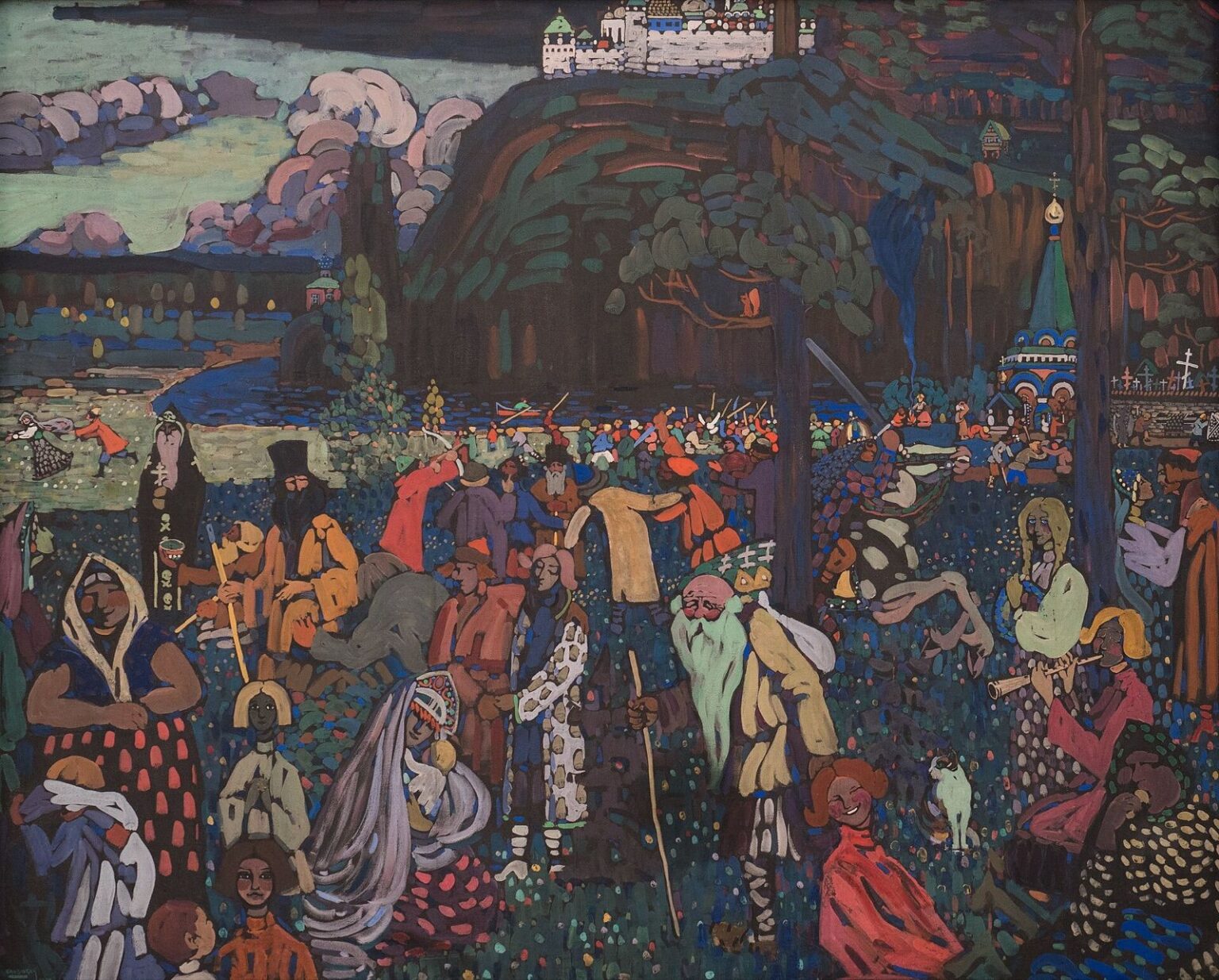
A painting by Wassily Kandinsky that has been returned to the family who owned it before Nazi persecution is about to go under the hammer. Kandinsky’s Das bunte Leben, a 1907 canvas returned to the heirs only in June 2023, will be offered by Christie’s in London on October 14, 2026, during Frieze Week, with an estimate that, according to ARTnews, exceeds 30 million dollars. The story intertwines art history and historical justice: a masterpiece from Kandinsky’s early maturity that for over half a century was exhibited in a German museum without the public knowing its true provenance.
Key points
- Das bunte Leben, painted in 1907 by Kandinsky, will be sold by Christie’s in London on October 14, 2026.
- The work, measuring 130 × 163 centimeters, was returned in June 2023 to the heirs of Hedwig Lewenstein-Weyermann.
- Confiscated during the German occupation of the Netherlands, it was removed from the Stedelijk Museum and sold at auction in October 1940.
- Before the London auction, the painting will be shown in Zurich, Paris, New York, and Hong Kong.
- According to ARTnews, Christie’s estimate exceeds 30 million dollars.
Kandinsky’s historic painting returned to the heirs and prepared for auction
Das bunte Leben will be one of the main lots in Christie’s 20th/21st Century: London Evening Sale, scheduled in the British capital to coincide with Frieze Week. The canvas, monumental in size for the period in which it was created, comes to market after a legal and family saga that lasted decades.
Auction details and preview tour
Before the sale on October 14, 2026, the work will go on an international tour organized by Christie’s: it will be on view in Zurich from September 2 to 4, in Paris from September 10 to 12, in New York from September 17 to 20, and in Hong Kong from September 22 to 29. In London the painting will be exhibited to the public from October 8, a few days before the auctioneer takes the rostrum. According to ARTnews, the auction house estimates that the painting could exceed 30 million dollars, a figure that places the work among the most anticipated lots of the autumn season dedicated to twentieth-century art.
Restitution after confiscation under Nazism
The restitution, which took place in June 2023, came at the end of a legal process linked to the German special commission on property looted during Nazism, which determined that the work had to be returned to the heirs of its rightful owners. The heirs of Hedwig Lewenstein-Weyermann obtained the painting from Bayerische Landesbank, which had formally held it for years. This step is part of a broader phenomenon of returning works taken from Jewish families during Nazi persecution, an issue that continues to intersect with the international art market.
Artistic significance and description of Das bunte Leben
Beyond its historical value related to restitution, Das bunte Leben is considered one of the key works in Kandinsky’s artistic development. It was painted in 1907 during the artist’s stay in Paris and was successfully exhibited and praised by critics at the Salon d’Automne in Paris that same year.
Influences and symbolism in the work
Kandinsky arrived in Paris in 1906 together with the painter Gabriele Münter, with whom he was romantically involved. In those years the city was one of the most vibrant centers of European pictorial experimentation: exhibitions presented works by Cézanne, Seurat, and Van Gogh, along with pointillism, post-impressionism, fauvism, and early cubist experiments. The couple frequented the Salon des Indépendants and the galleries of Berthe Weill, Ambroise Vollard, and Clovis Sagot, as well as the collections of the Stein family. In the composition, pilgrims, peasants, saints, noble figures, mothers, and children coexist in a space without a precise temporal setting. Numerous motifs recall Russian legends, folklore, and religious traditions that had fascinated Kandinsky for years, including a rider among the trees, an image destined to evolve into the later iconography of the Blaue Reiter.
Kandinsky’s early development and use of color
At the time it was created, Das bunte Leben was the largest canvas Kandinsky had ever tackled, a choice that also reflected his ambition to establish himself on the Parisian art scene. The artist addressed the theme of life in all its complexity, imagining it within a pastoral and utopian universe, a subject close to that explored by Henri Matisse in Bonheur de vivre (1905–1906) and by André Derain in La Danse (1906). In the work, color begins to take on an autonomous role, no longer simply descriptive but capable of expressing emotions and spiritual meanings, an evolution that anticipates the artist’s later abstract research.
Provenance and custodial history between war and dispersal
The history of the painting also tells the fate of a family collection overwhelmed by Nazi persecution and reconstructed only thanks to the tenacity of two heirs.
Ownership and confiscation during the Second World War
In November 1927 Das bunte Leben was purchased by the Dutch entrepreneur Emanuel Albert Lewenstein and his wife Hedwig Lewenstein-Weyermann. Emanuel ran Lewenstein, one of the best-known sewing machine companies in the Netherlands, and the couple built a collection of modern art thanks in part to their connection with Emanuel’s cousin, Paul Citroen, an artist and photographer trained at the Bauhaus, who introduced them to progressive circles in Berlin. With the German occupation of the Netherlands, the family’s assets were confiscated: in October 1940 the painting, then on loan to the Stedelijk Museum, was removed from the museum and sold at auction, ending up in the collection of the collector Salomon B. Slijper.
Post-war custody and museum loans
The work remained in the Netherlands for most of the post-war period, until 1972, when it was purchased by Bayerische Landesbank from the Slijper family. In 1973 it was granted on long-term loan to the Lenbachhaus in Munich, where it remained on public display for over fifty years. In the meantime, Emanuel and Hedwig’s children, Robert and Wilhelmine Lewenstein, devoted decades to searching for the works that had belonged to their parents. Through a long process of reconstructing the provenance, carried out with their own advisors and with Mondex Corporation, the heirs of Hedwig Lewenstein-Weyermann finally succeeded in obtaining the restitution of the painting from the Bavarian bank in June 2023.
The appearance of the painting on the market counts twice over: for the artistic value recognized in a pivotal work in Kandinsky’s formation, and for the precedent it represents in the dialogue between post-Nazi restitutions and the circuit of major international auctions, at a time when cases of contested provenance continue to influence the decisions of collectors and auction houses.
FAQ
When and where will Kandinsky’s Das bunte Leben be auctioned?
The painting will be sold by Christie’s in London on October 14, 2026.
What is the restitution history of Das bunte Leben?
The work was confiscated during the German occupation of the Netherlands in 1940, dispersed, and, after decades of research carried out by the heirs Robert and Wilhelmine Lewenstein, returned to the family in June 2023.
What makes Das bunte Leben artistically significant?
It is a key work from Kandinsky’s early period, incorporating influences from the Parisian avant-garde and Russian folklore, and exploring color as an emotional and spiritual element.
What is the painting’s provenance after the Second World War?
After its dispersal in 1940, the work passed to the collector Salomon B. Slijper, was purchased by Bayerische Landesbank in 1972, and was granted on long-term loan to the Lenbachhaus museum in Munich from 1973.
Content created with the assistance of artificial intelligence and with human editorial review.


