The exhibition Megalomanie, until July 18 at the Fondazione Nicola del Roscio. The search for the Absolute and the crisis of the object according to CANEMORTO.
After “Pescheria” (MATTA, Milan, 2023), “En Plein Air” (Spazio C21, Reggio Emilia, 2023) and “Il Restauro dell’Ipogeo Txakurreo” (TAM Museum, Matera, 2022), the artistic collective CANEMORTO has returned to exhibit, this time at the spaces of the Fondazione Nicola del Roscio, in Rome, with the exhibition “Megalomanie”, curated by Davide Pellicciari and Carlotta Spinelli.
Megalomanie, an exhibition between truth and fiction

An unexpected announcement, namely the alleged disappearance of the trio following a mysterious incident, consistent with the path taken by the group and with the context in which it previously moved, has further turned the spotlight on the exhibition. The event, deliberately enigmatic, on one hand draws attention to the performance, on the other generates reflections on the symbolic practice of the trio, devoted to the canine deity Txakurra, configuration of a sacred, media entity, which in some way watches over their research process, tracing a sense of continuity in the visual investigation.

Just like in previous exhibitions, “Megalomanie” pushes the game further, reflecting on the role of authority, of that guiding entity that becomes a driving element of the message, a message that, in turn, is traversed by different languages and that accompanies the reflection on the reliability and credibility of the mechanisms of the contemporary art system, and on the exposure and positioning of the artist in the various contexts in which their image is exploited.

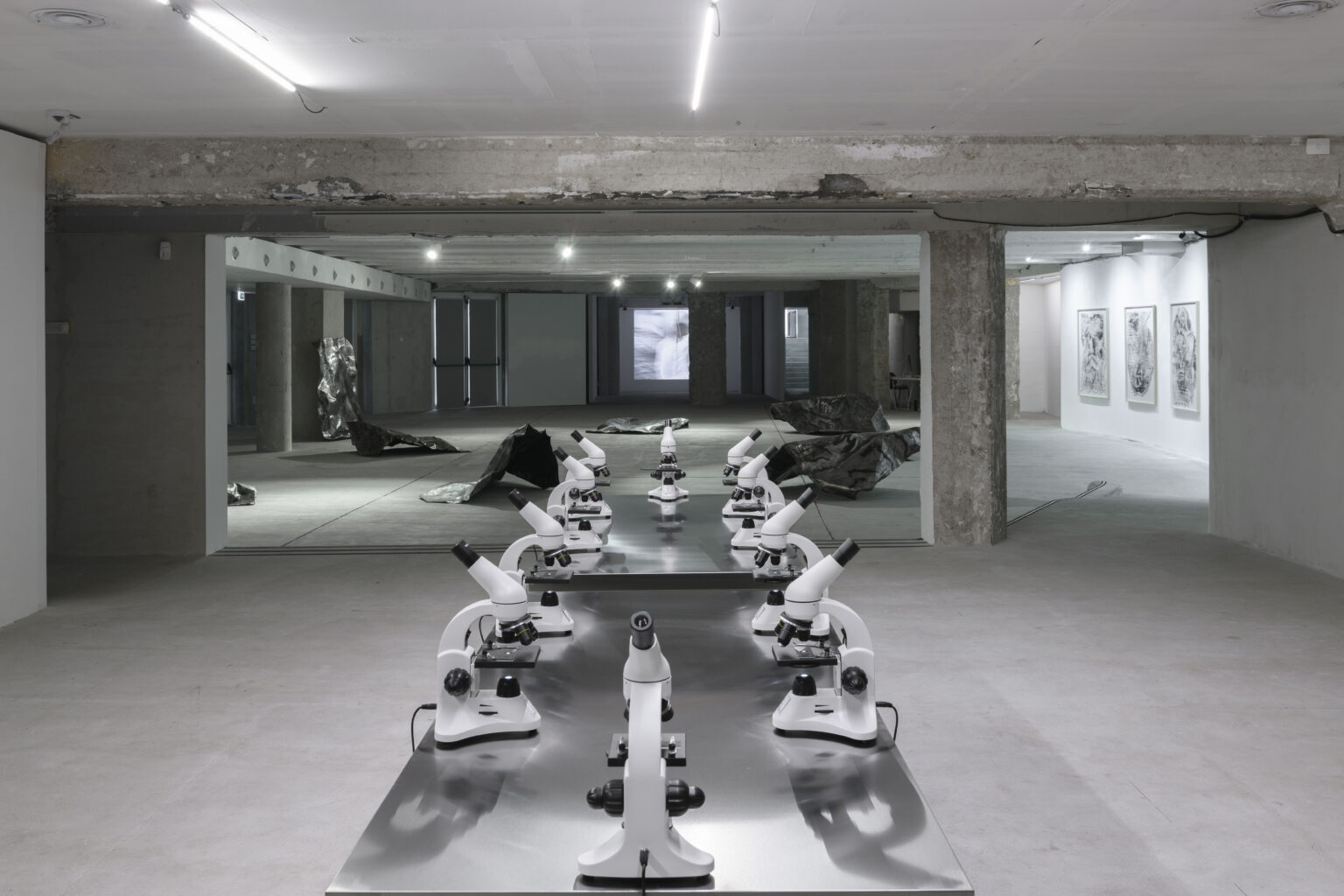
Confusing the planes between reality and fiction, the environment, continuous and almost lunar, seems suspended in anticipation of revelations, irreverent, stirring the visual and conceptual practice through a type of art that regenerates by proposing new ways of interpretation. Among these is the awareness that the object does not exhaust itself conditionally in the circumstances of the environmental narrative but radiates beyond, as clarified by the large calcographic works, initially intended to be intact for the exhibition, which remain crumpled, similar to the remains of a disintegrated celestial body that suddenly crashed onto Earth.
The search for the Absolute Work

The process of scenic remodulation and the junction points of the research are narrated in the film projection “La Recherche de l’Oeuvre Absolue”, which introduces the exhibition, a reference, perhaps, to the assonant work “La recherche de l’absolu” from 1834 by the Parisian writer Honoré de Balzac (1799-1850).
The protagonist Balthazar Claës, isolating himself in his chemistry laboratory, loses awareness of the world around him by obsessively dedicating himself to the pursuit of the ideal of the Absolute, ultimately sacrificing everything, including his relationship with his own family, for the achievement of a greater goal. This strengthens a concept that embraces a philosophical and transversal thought, namely how matter, undergoing various modifications due to the intervention of external means, produces the reality that surrounds us and how it itself, a child of an initial matrix, aspires to the primordial core of creation.

The intent to create large-sized intaglio prints, the representation of failure and the destruction of matter, as if following a chemical explosion, harks back to the imagery of the scientist tormented by the achievement of a goal set above all human expectation.
The project room of the Foundation transformed into a scientific laboratory

From micro to macro and vice versa, a series of telescopes on display seem to contrast with the gigantic metal plates whose material has taken on a new form, emphasizing how experience transforms everything, bringing it to a new stage of knowledge. For each telescope, there are just as many small-format plates worked with the support of professionals and artisans in the same project room of the Foundation, conceived, in this case, as a real laboratory.
“Megalomanie” is configured as an exhibition that abdicates its own function, the trio sabotages the primary intent of the exhibition itself, warning the viewer of the changed conceptual condition that awaits them, as in an initiatory ritual. If the artist is called outside of their own role, inevitably finding themselves dealing with the logics of the market and not only that, the visitor, on the other hand, has the power to witness and, in part, to contribute to the destruction of the function attributed to them.
The exhibition is an invitation to visit a laboratory with no other expectation than to reject the axiom or the preconceived, opening up to the questions posed by a system in which the product absorbs the work and its Absolute.
Read also: The Costume Institute exhibition at the Met changes theme after the Galliano affair · Cancellation of the John Galliano exhibition: a patron threatens to withdraw the bequest