In New York there is a 31-year-old gallerist who in just two years has managed to place his artists both at the Whitney Biennial and at the Venice Biennale, a double result that rarely happens in the contemporary art market, and almost never to someone who opened their gallery less than two seasons ago. His name is David Pagliarulo, he founded David Peter Francis in Chinatown in 2024, and his story clearly shows how a young gallerist in New York can build credibility starting almost from scratch, focusing on little-known artists instead of already established names.
Key points
- Pat Oleszko, a 79-year-old performer represented by David Peter Francis, won the Whitney Biennial’s Bucksbaum Award, a $100,000 prize.
- The gallery represents two of the artists featured in this edition of the Whitney Biennial: Pat Oleszko and Emilie Louise Gossiaux.
- Carrie Schneider, also represented by David Peter Francis, is featured at the Venice Biennale with a photographic installation.
- David Pagliarulo, 31, founded the gallery in 2024 during what he himself described as a down market, which is now gradually improving.
- The gallery keeps a minimal structure: just two people in total and participation in very few art fairs per year.
The beginnings of a young gallerist in New York
Pagliarulo does not come from the art world either by family background or by specialized academic training: he grew up in Tampa, Florida, a city he himself describes as far from cultural circuits, and he discovered the sector almost by chance, by spending time in a friend’s artist studio. He studied visual culture at the American University of Paris, with a specialization in art history, at the time seeing the subject more as an academic path than a professional future.
After graduating in 2018 he joined Fort Gansevoort as an intern, a New York gallery known for supporting less canonized artists such as Myrlande Constant and Shuvinai Ashoona. From there his path solidified: first Chart, then the role of director at Marinaro gallery. It was during an Uber ride in 2021, after a gallery dinner, that artist Elaine Reichek suggested he go out on his own. The advice became reality in 2024, with a first group show that included Peter Hujar, Gonzalo Reyes Rodriguez, and Lucas Odahara, the latter two now permanent parts of the gallery’s roster.
The name David Peter Francis does not correspond to any real person: Pagliarulo combined the name of his father, Peter, and that of his grandfather, Francis, neither of whom had any connection to the art world. “I wanted to involve them somehow,” he said, calling the choice “strangely Catholic.”
Two biennials, one gallerist behind the scenes
The most concrete result of his strategy can be measured in this double institutional presence: two artists at the Whitney Biennial and one at the Venice Biennale at the same time, a milestone that very few dealers, young or established, manage to reach together.
Whitney Biennial: Pat Oleszko and Emilie Louise Gossiaux
Pat Oleszko was almost unknown to the wider New York public until January, when SculptureCenter dedicated a retrospective to her built entirely around her inflatable sculptures. Two months later her 1995 work, Blowhard, a huge green face with a tongue of fire, became one of the most appreciated presences at the Whitney Biennial. In the summer came the most important recognition: the Bucksbaum Award, the $100,000 prize awarded by the Biennial.
Behind that visibility is the show that Pagliarulo dedicated to her in June 2024, set up across two gallery spaces after months of persistent emails to which the artist, initially wary, eventually responded. Oleszko had not had a solo show in New York since 1990: the guaranteed audience was minimal, the commercial risk obvious. Alongside her, in the same edition of the Whitney Biennial, appears Emilie Louise Gossiaux, also represented by David Peter Francis, with drawings and a sculpture dedicated to her late guide dog.
Venice Biennale: Carrie Schneider
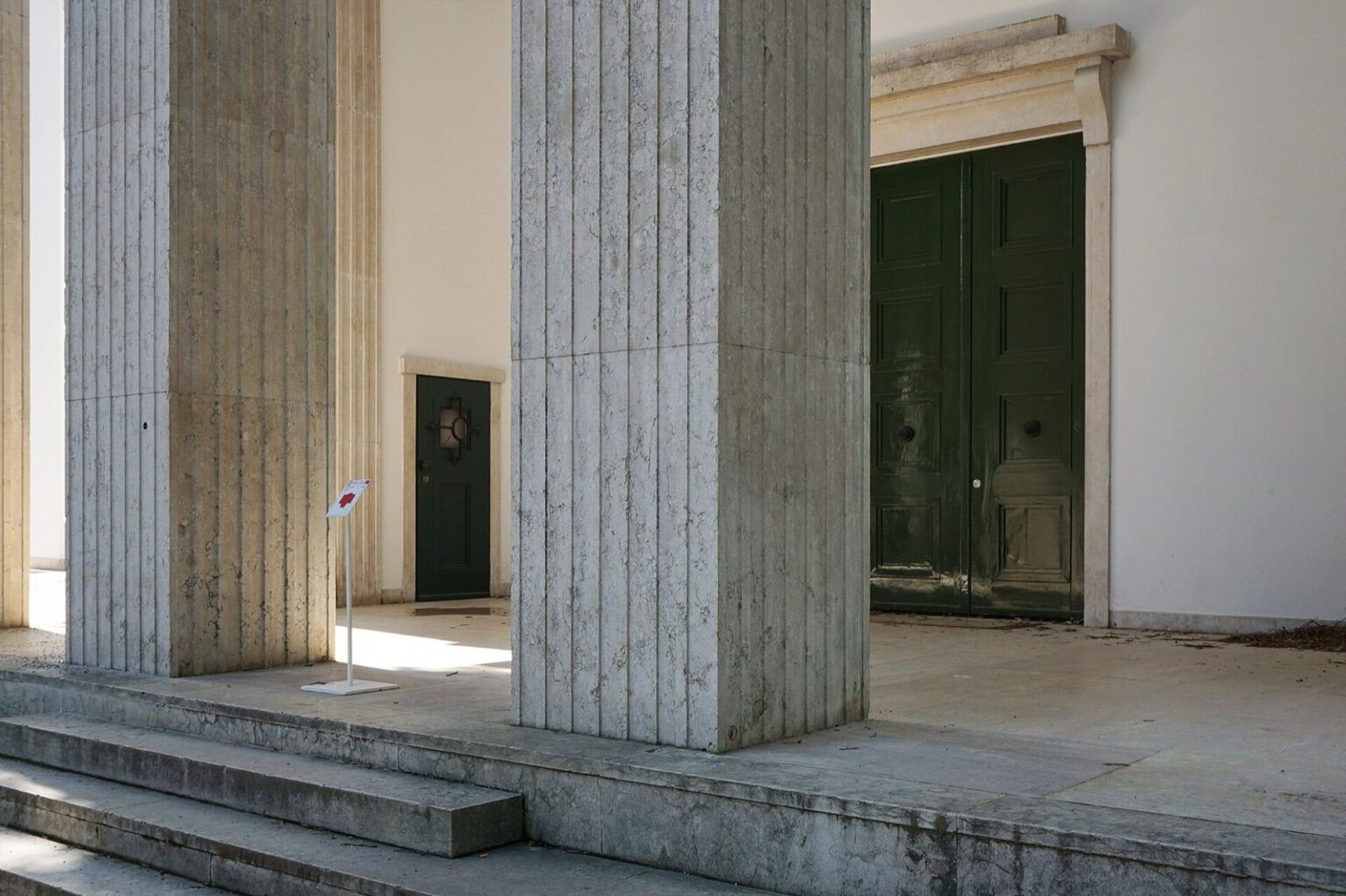
While Oleszko and Gossiaux were at the Whitney, Carrie Schneider, an artist known for her photographic installations built with huge rolls of chromogenic paper, was selected for the Venice Biennale. Schneider had already exhibited at Chart, the gallery where Pagliarulo worked before founding David Peter Francis, which now represents her exclusively. Her solo show in the New York space is closing right these days.
This combination—one artist at the Venice Biennale and two at the Whitney Biennial in the same time frame—remains rare even among gallerists with decades of experience. For a dealer who has not yet turned thirty-two, it is a sign that the market is watching with growing attention.
The gallery’s philosophy and its relationship with artists
Why does this detail matter for those observing the art market? Because the selection of David Peter Francis shows that major international institutions are rewarding small galleries capable of identifying artists before they become “bankable,” a path that directly influences the future prices of these names and collectors’ interest in works that are still accessible.
Pagliarulo describes his work as a choice guided more by trust in the artists than by certainty of sales. “I’m really motivated to do a good job for the artists,” he said, adding that for them these are career-defining moments. The gallery focuses on conceptual and underrepresented artists, or those who have never really entered the canon: from Bryan LaPlante himself, a former security guard during government meetings on atomic weapons in the postwar period, to William Scott, a self-taught artist who depicts an imaginary city with a majority Black and Latino population called Praise Fiasco.
It is an approach that the artists themselves describe as ego-free. Oleszko said she does not recognize in him “the ego or testosterone-charged control” typical of many other gallerists, calling the collaboration with him “refreshing and pleasant.”
Low costs, few fairs, lots of selectivity
The gallery’s economic sustainability depends on a deliberately minimal structure: only two people on staff, including Pagliarulo, and a limited presence at international fairs. This summer it debuted at the Swiss edition of Art Basel with a booth dedicated to Gossiaux’s work, but it remains one of the few fair outings of the year.
This choice responds to a market reality that is anything but simple: many New York galleries specializing in conceptual art, like David Peter Francis, now face closure risks linked to fair costs and monthly rents. Pagliarulo opened his gallery in what he himself called a “down market,” but notes that conditions have progressively improved since then, in parallel with other galleries, such as Ramiken Crucible and 47 Canal, which chose to focus on art that was hard to monetize immediately after the 2008 financial crisis and still managed to survive.
When asked whether money is a source of anxiety, the answer is direct: “I think it always is.” A frankness that, combined with the results achieved at the biennials, is making David Peter Francis a case watched with interest by collectors and other industry players, just as the New York contemporary art market struggles to distinguish between galleries destined to close and those capable of consolidating.
Exhibitions, ambitions, and deliberate limits on growth
The gallery’s program has maintained an ambitious pace even outside the biennials. In January David Peter Francis presented the group show “Snake, Turtle, Alligator,” built around Bryan LaPlante’s drawings and accompanied by works by Gregg Bordowitz and Lucy Raven. In May came William Scott’s solo show. In September a show is planned dedicated to Unglee, a French filmmaker and photographer who is practically unseen in the United States.
Despite the results, Pagliarulo has no intention of expanding the structure. He explained that galleries complicate their lives precisely when they grow too much, and that his goal is to stay close to the concrete work with the artists, without drifting away from it. It is a choice that contrasts with the logic of scale typical of many galleries seeking consolidation, and that makes the case of David Peter Francis an atypical example: growth in reputation and institutional visibility without proportional growth in the company’s structure.
FAQ
Who is David Pagliarulo and what makes his gallery distinctive?
David Pagliarulo is a 31-year-old New York gallerist who founded David Peter Francis in 2024 and represents artists featured in major exhibitions such as the Whitney Biennial and the Venice Biennale.
Which David Peter Francis artists are featured at the Whitney Biennial?
Pat Oleszko and Emilie Louise Gossiaux are the two artists represented by David Peter Francis in this edition of the Whitney Biennial.
What distinguishes David Pagliarulo’s approach to running the gallery?
Pagliarulo focuses on supporting underrepresented artists with conceptual and poetic works, maintains a minimal structure with very few staff and limited participation in fairs, and is described by artists as a collaborative, ego-free gallerist.
How has the market context affected the David Peter Francis gallery since its founding?
Pagliarulo opened the gallery in 2024 during a down market, but conditions have progressively improved since then, helping the gallery remain stable.
Read also: Return of works of art stolen by the Nazis in Holland: a Van Goyen comes back after 58 years · The Botero style conquers New York with a historic exhibition at Sotheby’s
Content produced with the assistance of artificial intelligence and with human editorial review.