


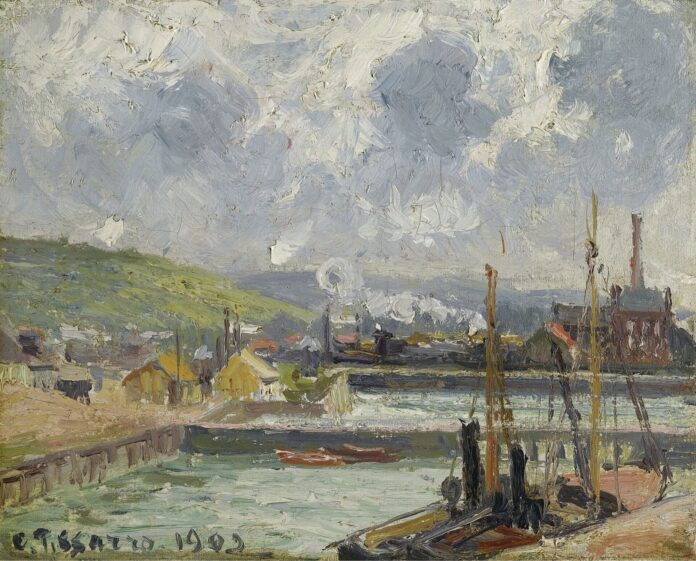
A painting by Camille Pissarro sold by Sotheby’s in London for over one million pounds has become the focus of a legal battle that has brought back to light the still-open wounds of Nazi looting. The legal dispute over the Pissarro painting titled Darse de pêche et bassin Duquesne, sold on 25 June 2024 for £1.2 million, is now in the hands of a Paris court, called upon to decide whether the transaction should be annulled. Seven heirs of the Jewish banker Salomon Flavian, whose collection was confiscated by the Nazis in Paris in 1941, claim they never gave their consent to the sale of the work.
Key points
- Pissarro’s painting Darse de pêche et bassin Duquesne was sold by Sotheby’s in London on 25 June 2024 for £1.2 million.
- Seven heirs of Salomon Flavian are seeking to have the sale annulled, arguing that only two family members had signed the agreement.
- Mondex Corporation, tasked with obtaining the heirs’ consent, maintains that the work was never looted by the Nazis.
- Research by curator Mary Kate Cleary found no evidence of Nazi confiscation, but is disputed by the heirs’ lawyers.
- The Paris court’s verdict is expected on 5 November.
Legal dispute over the sale of a Pissarro painting
The case concerns a landscape depicting the port of Dieppe, painted by Pissarro in 1902. Sotheby’s catalogue indicated that the work had belonged to Flavian in the 1930s and that it was recorded in the Répertoire des biens spoliés, the register of looted property published by the French government in 1947. The same information appears in the Pissarro Critical Catalogue of Paintings, edited by Joachim Pissarro, the painter’s great-grandson, and published in 2005.
Despite these references, the auction house put the work up for sale specifying that it was a transfer “in accordance with an agreement between the current owner and the heirs of Salomon Flavian.” Sotheby’s explained in court that consent had been obtained by Mondex Corporation, a Toronto-based company specializing in the recovery of works taken during the Holocaust.
During a hearing on 18 September, however, the seven plaintiffs stated that the agreement had been signed only by two relatives, Gilles and Nicolas Flavian, without the others ever being consulted. According to court documents, through the contract signed with the seller, the two heirs, represented by Mondex, would have waived all rights to the painting as part of the sale. The other family members, according to what has emerged, learned of the transfer only months later, through a letter dated 17 October 2024 in which Mondex informed them that it had accepted on their behalf a “relatively modest” share of 8% of the net sale price, “in exchange for their cooperation.” The same letter, seen by The Art Newspaper, included an expense report and a 16% commission charged to the two signatory heirs.
Disputed provenance: what the research says
The central issue in the case concerns not only consent, but the very nature of the painting: was it really a work looted by the Nazis? Mondex argues that it was not, and this position is at the heart of the entire legal affair.
Mondex’s lawyer, Melina Wolman, stated in court that the company believes the work was never confiscated by the Nazis and that it was mistakenly recorded as looted property. James Palmer, founder of Mondex, explained to The Art Newspaper that the company adopted this position “on the basis of that evidence, and in the interest of rigor and intellectual honesty.” According to Wolman, if Mondex had been convinced that the work was looted, it would naturally have sided with the plaintiffs.
Mary Kate Cleary’s research
Mondex and Sotheby’s conviction is based on a study conducted by Mary Kate Cleary, provenance curator at the Princeton University Art Museum, commissioned by the sellers of the work. Cleary concluded that the view of Dieppe was not among the 45 paintings and sculptures in the Flavian collection confiscated in 1941, and that no trace of the painting appears in the confiscation lists of the Einsatzstab Reichsleiter Rosenberg (ERR), the Nazi task force responsible for looting hundreds of thousands of works during the Second World War. Based on Pissarro’s catalogue raisonné published by Paul Rosenberg in 1939 and on some notes found in his archives, Cleary hypothesized that the dealer had in fact sold the work around 1938 to the well-known British collector Edward Le Bas.
The heirs’ objections
Corinne Hershkovitch, the plaintiffs’ lawyer, has however challenged this reconstruction, arguing that works were regularly removed from the ERR lists thanks to the collaboration of unscrupulous dealers. Hershkovitch described Rosenberg’s posthumous notes as inaccurate, pointing out that his catalogue did not mention at all that Flavian had owned the work since 1935. She also suggested that Rosenberg’s catalogue raisonné may have confused Darse de pêche et bassin Duquesne with another Pissarro actually purchased by Le Bas, criticizing Cleary’s decision to base the study exclusively on Rosenberg’s archives “without comparing them with those of the Flavian family.” Cleary did not respond to requests for comment.
Disputed jurisdiction and pending judgment
In addition to the issue of provenance, the case is complicated by a non-negligible procedural problem. Remi Sermier, Sotheby’s lawyer, has challenged the jurisdiction of the Paris court over a sale that took place in London between two clients “without any connection to France.” This jurisdictional aspect could significantly affect the outcome and enforceability of any verdict, regardless of how the substantive issue of the work’s provenance is resolved. The court is expected to rule on 5 November.
Disputes involving Mondex Corporation
The affair also sheds light on the controversial role Mondex has played in the case. Wolman complained that the company has been “the victim of relentless harassment,” even though it was neither the seller nor the buyer of the work, nor did it act as an intermediary in the sale. Palmer specified that his company did not receive any payment for the transaction, without providing further details on the financial arrangements. This is not the first time that Mondex’s procedures and high commissions have generated disputes: the company has previously been involved in similar controversies related to other works returned in the context of post-Holocaust restitution proceedings.
The case remains emblematic of the difficulties that still accompany claims over works taken during the Holocaust: incomplete archives, conflicting testimonies and economic interests that intertwine with historical research. For the art market, the affair highlights how delicate it is to certify a work’s provenance before putting it up for sale: an uncertainty that can weigh on its value, its future saleability and the reputation of auction houses and intermediaries involved in transactions linked to Jewish collections dispersed during the war.
FAQ
What is the main dispute concerning the Pissarro painting sold by Sotheby’s?
Seven heirs of Salomon Flavian argue that the sale should be annulled because only two heirs had given their consent, and they contest the legitimacy of that agreement.
Has it been confirmed that the Pissarro painting was a work looted by the Nazis?
The provenance research conducted by Mary Kate Cleary found no evidence of Nazi confiscation and linked the painting to British collector Edward Le Bas already before the Second World War.
Why is the jurisdiction of the Paris court over the sale handled by Sotheby’s being challenged?
Sotheby’s lawyer argued that the sale took place in London between two parties with no connection to France, thus calling into question the competence of the Paris court.
What role did Mondex Corporation play in this affair?
Mondex commissioned the provenance research and obtained the consent of some heirs, but denies that the painting was looted and claims to have been subjected to harassment during the proceedings.
{“@context”:”https://schema.org”,”@type”:”FAQPage”,”mainEntity”:[{“@type”:”Question”,”name”:”What is the main dispute concerning the Pissarro painting sold by Sotheby’s?”,”acceptedAnswer”:{“@type”:”Answer”,”text”:”Seven heirs of Salomon Flavian argue that the sale should be annulled because only two heirs had given their consent, and they contest the legitimacy of that agreement.”}},{“@type”:”Question”,”name”:”Has it been confirmed that the Pissarro painting was a work looted by the Nazis?”,”acceptedAnswer”:{“@type”:”Answer”,”text”:”The provenance research conducted by Mary Kate Cleary found no evidence of Nazi confiscation and linked the painting to British collector Edward Le Bas already before the Second World War.”}},{“@type”:”Question”,”name”:”Why is the jurisdiction of the Paris court over the sale handled by Sotheby’s being challenged?”,”acceptedAnswer”:{“@type”:”Answer”,”text”:”Sotheby’s lawyer argued that the sale took place in London between two parties with no connection to France, thus calling into question the competence of the Paris court.”}},{“@type”:”Question”,”name”:”What role did Mondex Corporation play in this affair?”,”acceptedAnswer”:{“@type”:”Answer”,”text”:”Mondex commissioned the provenance research and obtained the consent of some heirs, but denies that the painting was looted and claims to have been subjected to harassment during the proceedings.”}}]}
Content produced with the assistance of artificial intelligence and with human editorial review.

With a degree in communications, she also holds a master’s degree in publishing and writing. Writer of articles from an SEO perspective, with care for indexing in search engines.

