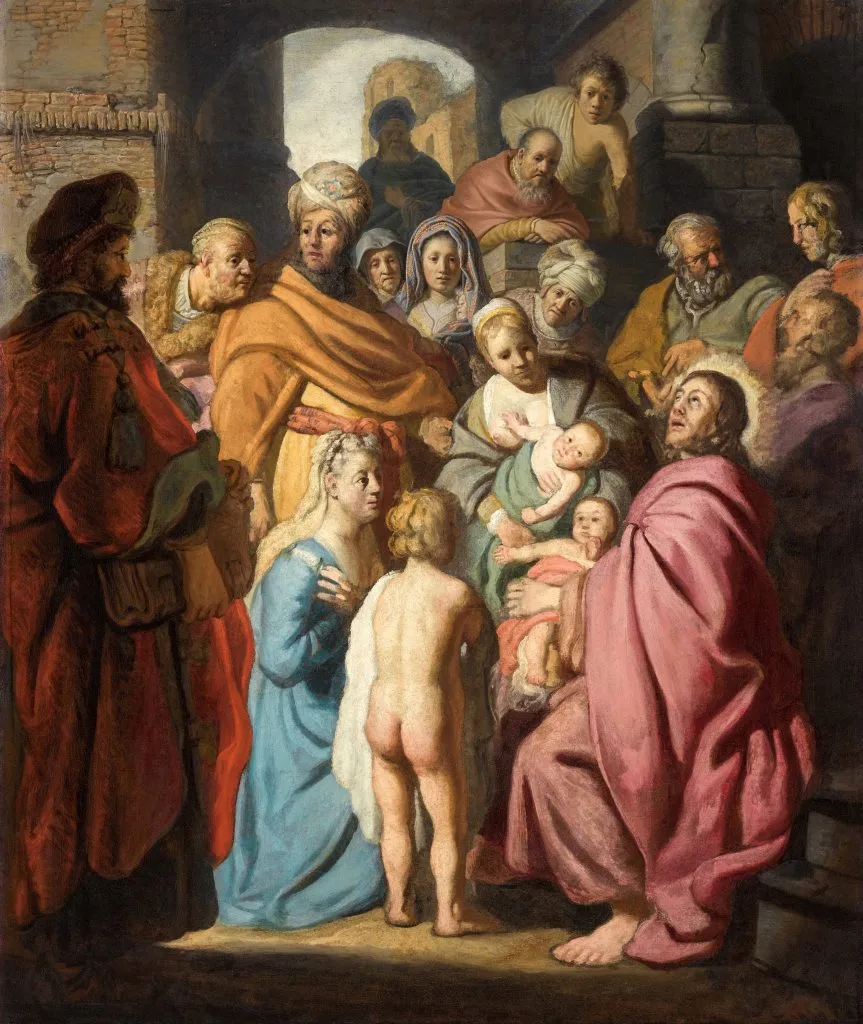
A youthful masterpiece by Rembrandt has been rediscovered after centuries and is now set to conquer the international art market. This work, an exceptional painting by Rembrandt dating back to 1627, will soon be presented to the public during a prestigious sale in London by Sotheby’s.
What story lies behind the rediscovered Rembrandt painting?
In 1620, the young man left university in Leiden, dashing his parents’ hopes. After costly apprenticeships, he returned home from Amsterdam in 1627. To prove that the money was not wasted, he painted an extraordinary scene.
The work, titled Let the Little Children Come Unto Me, remained in obscurity due to later overpainting. Additionally, the canvas lacks the artist’s typical light contrasts and is unusually large to be turned into an engraving.
How was the prestigious provenance reconstructed?
The Amsterdam collector Floris Soop purchased the painting, which was then sold by his son in 1663. It later reappeared in West Berlin in the mid-20th century. In 2014, the current owner bought it in Cologne for €1.5 million, cataloged as Dutch school.
That said, experts recognized the master’s features in a character at the back staring at the viewer. Next to him appear the father, the mother with a blue veil, and other family members.
| Price / Value | Owner / Event | Year |
| Not available | Completion of the work in Leiden | 1627 |
| Not available | Transfer of the work by Floris Soop’s son | 1663 |
| €1.5 million | Purchase at auction in Cologne | 2014 |
| £8 – £12 million | Scheduled sale at Sotheby’s auction | 1 July |
What secrets does the restoration of the work reveal?
The face of Jesus recalls a work from 1626 on the expulsion of the merchants from the temple. However, the artist left the canvas unfinished. A second author completed the disciples on the right several years later.
Overall, a decade-long restoration revealed the authenticity of the work. A removed detail showed a man with a turban. This symbolized openness towards non-Christian faiths, later censored with a local cap.
Why does this painting contrast with the religious dogmas of the time?
During the Thirty Years’ War, Leiden welcomed thousands of refugees, creating strong internal tensions. By showing a crowd welcomed by Christ, the author openly supported tolerance. Furthermore, the work openly contrasts the rigid Calvinist doctrine on infant predestination.
In conclusion, the upcoming Sotheby’s auction in London, scheduled for July 1, represents a historic event for collectors. This rare painting by Rembrandt combines the freshness of his youthful works with a universal message of inclusion.