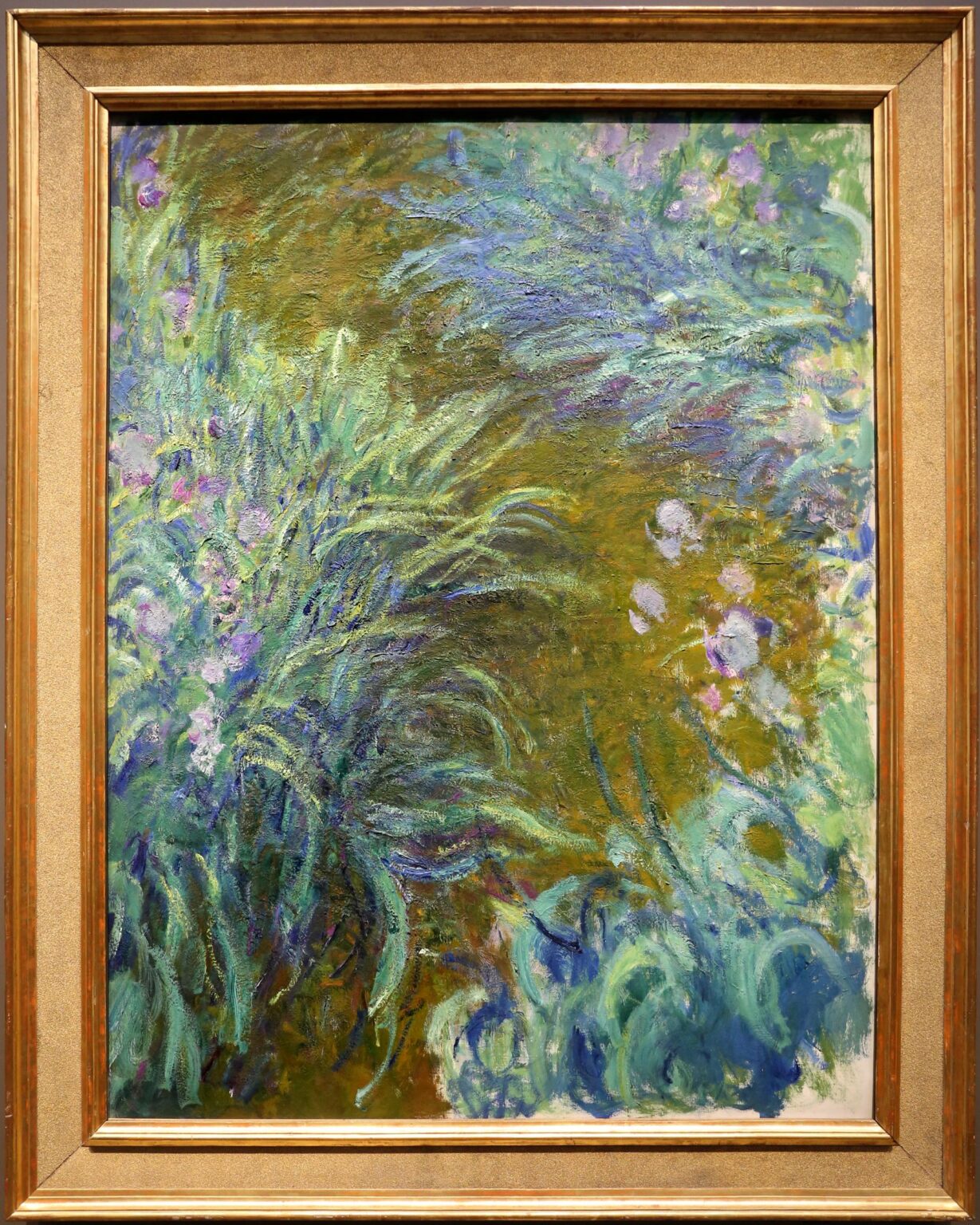
The painting Iris by Claude Monet has set a new auction record for a work sold in France. Sotheby’s Paris sold it for 50 million euros, equal to 56.2 million dollars.
Key points
- Iris (1924-25) was sold by Sotheby’s Paris on October 22, 2026 for 50 million euros (56.2 million dollars), more than double the minimum estimate of 22 million euros.
- It is the highest price ever paid for a work of art sold at auction in France, surpassing the 43.2 million euros for Modigliani’s Tête de Caryatide, sold by Christie’s Paris in 2010.
- The painting was part of the Schlumberger collection, consisting of 28 works with a total estimate of more than 40 million euros.
- Three early paintings by Paul Cézanne from the same collection were designated national treasures and withdrawn from sale; according to one source they will be acquired by the Musée Granet in Aix-en-Provence, according to others the City of Aix-en-Provence intends to acquire them for the Musée Granet.
- The sculpture La Valse by Camille Claudel fetched 832,000 euros, exceeding the highest estimate.
Record sale of Monet’s Iris by Sotheby’s in Paris
The canvas, sold on October 22, 2026, more than doubled the minimum estimate set by the auction house. It is the highest auction record ever achieved by a work sold in France.
Auction details and final price
Iris (1924-25), never before exhibited to the public, is monumental in format at almost two meters. It came to the block with an estimate between 22 and 30 million euros, the highest ever assigned to a painting presented at a French auction. A 45-minute bidding battle ended with the sale to a private collector in Asia.
Comparison with previous auction records in France
The final price surpasses the previous record, held by the Tête de Caryatide by Amedeo Modigliani, sold for 43.2 million euros (48.4 million dollars) by Christie’s Paris in 2010. Separate, however, remains the absolute record for a work by Monet worldwide, still held by Meules (1890), sold for 110.7 million dollars (98.7 million euros) by Sotheby‘s New York on May 14, 2019.
The Schlumberger collection of Monet and other auction highlights
Iris was the centerpiece of the sale “La Collection Schlumberger. Le Temps retrouvé”, 28 works with a total estimate of more than 40 million euros. Alongside Monet were works by Cézanne, Gustave Courbet and Camille Claudel.
The provenance of the painting runs from the artist’s estate to his son Michel Monet, then to the Galerie Katia Granoff, before entering the Schlumberger collection. Jeanne Schlumberger built the collection with the help of the gallerist, starting in the 1950s.
Monet works sold from the Schlumberger collection
Three other Monet paintings from the same collection went to auction. Saule Pleureur (1918-19) was sold for 9.6 million euros (10.7 million dollars) within estimate, as was La Maison à Travers les Roses (1925-26), sold for 2.5 million euros (2.8 million dollars). La Seine à Vernon, Arbres (1894) instead reached 4.2 million euros (4.7 million dollars), more than double the high estimate.
Sale of the sculpture La Valse by Camille Claudel
Among the lots was also La Valse (1895) by Camille Claudel, depicting two dancers in an off-balance embrace. The work fetched 832,000 euros (933,710 dollars) against an estimate of 400,000-600,000 euros.
Cézanne paintings withdrawn from sale and designated national treasures
Three early paintings by Paul Cézanne – La Ferme, Arbres au Bord de la Rivière and Ciel Entre les Arbres, created between 1862 and 1864 as part of a mural in the family home at Jas de Bouffan – were designated national treasures. According to one source, they were pre-empted by the City of Aix-en-Provence, with the support of the French Ministry of Culture, and will be acquired by the Musée Granet; according to other sources, they were withdrawn from the sale a few hours before the auction and the City intends to acquire them for the Musée Granet. “There could be no more appropriate homecoming for these three extraordinary paintings,” said Thomas Bompard, co-head of the modern and contemporary art department at Sotheby’s France.
Artistic and historical significance of Monet’s Iris
Iris represents the final phase of Monet’s exploration of color, light and reflection, a language that anticipated twentieth-century painting movements. The sale comes in the year of the centenary of the artist’s death, which occurred on December 5, 1926, celebrated in Paris by two exhibitions: “Monet, Painting Time” and “Stories of Landscapes, from Monet to Hockney”.
Monet’s final phase, between the iris series and expert opinions
Monet’s interest in irises began with the First World War, when the artist withdrew to his oasis in Giverny. The flower, his favorite, appears in around twenty canvases painted in two distinct phases: this late canvas is their culmination, dissolving the boundaries between objects and their reflections thanks to a scale that immerses the viewer, an approach later taken up by the abstract expressionists.
The previous record for a Monet with an iris theme was 10.8 million pounds, paid at Christie’s London in 2015. The highest price for a work from the late period had instead remained at 3.2 million euros, paid in 2007 at Artcurial Paris for Iris Jaunes (1924-25). “He painted a fragment of reality to give an idea of the immensity of the world. It is not the description of a garden, but a pictorial world,” explained Marianne Mathieu, former curator of the Musée Marmottan Monet and expert on the artist. “Iris is an example of Monet’s final work: giving a new definition of what painting should be.”
Content produced with the assistance of artificial intelligence and with human editorial review.