

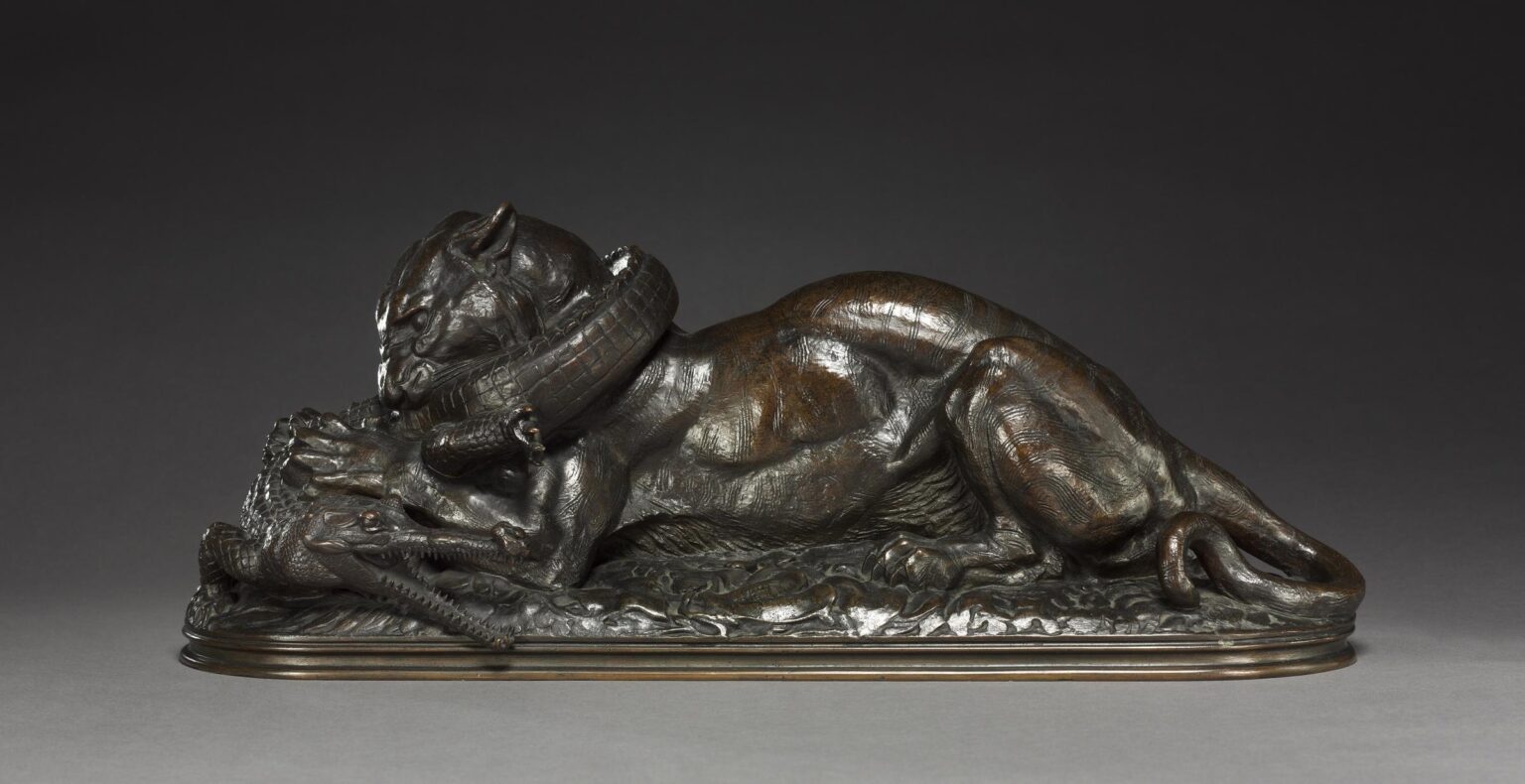
The market for animal sculptures from the 19th and 20th centuries hides prices ranging from a few hundred to millions of euros. Three names dominate the scene: Antoine-Louis Barye, Rembrandt Bugatti, and François Pompon.
Key points
- The market runs at two speeds: 19th-century prices have collapsed, while 20th-century masterpieces have reached record figures.
- A Three Panthers Walking by Bugatti reached 3.6 million euros in 2024; a Grand Deer by Pompon fetched 793,600 euros hammer price in 2021, according to Artprice data.
- Since 1904 the Hébrard foundry has introduced bronze numbering, limiting originals to twelve examples.
- The works of François-Xavier Lalanne and Claude Lalanne have set recent records: over 18 million euros at Christie’s in 2023 and 28.5 million euros at Sotheby’s last April.
- Fakes and illegal castings are widespread, especially for Pompon: only nineteen Bears made during his lifetime versus around five hundred examples that come up at auction every year.
Two-speed dynamics in the market for animal sculptures
The market for animal sculptures is difficult to interpret because it blends several factors: the artist’s fame, the casting date if it is bronze, the number of existing examples. It is not enough to look at the name on the label to understand the value of a work.
Main artists influencing the market
Antoine-Louis Barye (1795–1875), Rembrandt Bugatti (1884–1916) and François Pompon (1855–1933) remain the three benchmarks in the field. Pompon’s White Bear has become an icon.
Differences in valuation between 19th- and 20th-century sculptures
The market is, indeed, two-speed: 19th-century prices have collapsed, while 20th-century works have reached absolute records. For Bugatti, Three Panthers Walking achieved 3.6 million euros in 2024; for Pompon, a Grand Deer fetched 793,600 euros hammer price in 2021, according to Artprice.
Evolution of bronze casting techniques and impact on the market
The concept of rarity has changed profoundly over time and has reshaped the valuation of animal sculptures. In the second half of the 19th century, sculpture was often a decorative element produced in large series through sand casting: some models by Barye were issued by the Barbedienne foundry in over a thousand copies, explains gallerist Xavier Eeckhout, an expert in animal sculpture.
Numbered and limited editions introduced by the Hébrard foundry
Since 1904, at the Hébrard foundry, bronze numbering appeared, which limited originals to twelve copies (eight commercial proofs plus four artist’s proofs), with a return to lost-wax casting to produce limited editions. Demand for the great 20th-century names, from Bugatti to Pompon up to Édouard-Marcel Sandoz, has exploded, generating records in decorative arts and design sales.
Finding one’s way is not easy: Barye himself can be worth 10,000 euros or 400 euros depending on the casting, explains Thomas Müller, auctioneer at the auction house Crait + Müller. What matters is whether it is a period casting, a casting without the founder’s mark or a posthumous Barbedienne casting; among Barbedienne bronzes there are even the so‑called “gilded prints”, of higher quality than the standard production.
All experts recommend focusing on authentic bronzes, made during the artist’s lifetime, to avoid posthumous castings.
Original editions by Bugatti and the exception to posthumous castings
Bugatti is a special case: he did not work personally on his own castings, because his pieces are original editions produced by the Hébrard founder. For this reason, emphasizes Alain Richarme of the Univers du Bronze gallery, the concern about posthumous castings that applies to other sculptors does not apply to him.
Auction records and market values
Recent high-value sales of Lalanne’s works
The Lalanne phenomenon has pushed the bar even higher: over 18 million euros for the Rhinocrétaire by François‑Xavier Lalanne at Christie’s in 2023, and 28.5 million euros last April at Sotheby’s for a series of mirrors by Claude Lalanne that belonged to Yves Saint Laurent and Pierre Bergé. Since the sale of the designer’s and his partner’s collection in 2009, the Lalanne couple have continued to set records.
Millionaires and major decorators, including Peter Marino, have driven up the value of their works, turned into true status symbols. Lalanne pieces are sold in Paris also through galleries such as Mitterrand, Chastel‑Maréchal and Univers du Bronze.
Authenticity challenges and advice for collectors
Buying animal bronzes requires rigorous expertise, because the authenticity market for Pompon’s sculptures is among the most exposed to counterfeiting in the field.
Spread of fakes and illegal foundries
Pompon is the most copied artist: he made nineteen Bears during his lifetime, yet around five hundred go through auction every year, warns Xavier Eeckhout. The proliferation of illegal foundries makes it essential to turn to galleries and auction houses supported by experts, with descriptions that truly match the object. The annual Bestiary sale at the auction house Millon, curated by Antonio Casciello, offers an additional guarantee framework for collectors.
Advice on buying originals produced during the artist’s lifetime
Those looking for a more accessible entry point can turn to original models in plaster, terracotta or stoneware, including works by Pompon and the Sèvres manufactory, with unique or rare pieces between 2,000 and 10,000 euros. An alternative is lesser-known sculptors: the Group of Twelve founded by Pompon includes Georges Lucien Guyot, Simone Boutarel, Anne‑Marie Profillet, whose renown has grown; Nicolas Bourriaud is dedicating an exhibition to them at the end of 2025.
Xavier Eeckhout suggests buying bronzes by Micheline Bablot around 3,000 euros. Alain Richarme instead looks to contemporary animal sculpture: according to him, Hubert Le Gall, among the best contemporary artists in the genre, is not yet too expensive and his works are destined to increase in value in the coming years.
Content produced with the assistance of artificial intelligence and with human editorial review.


