

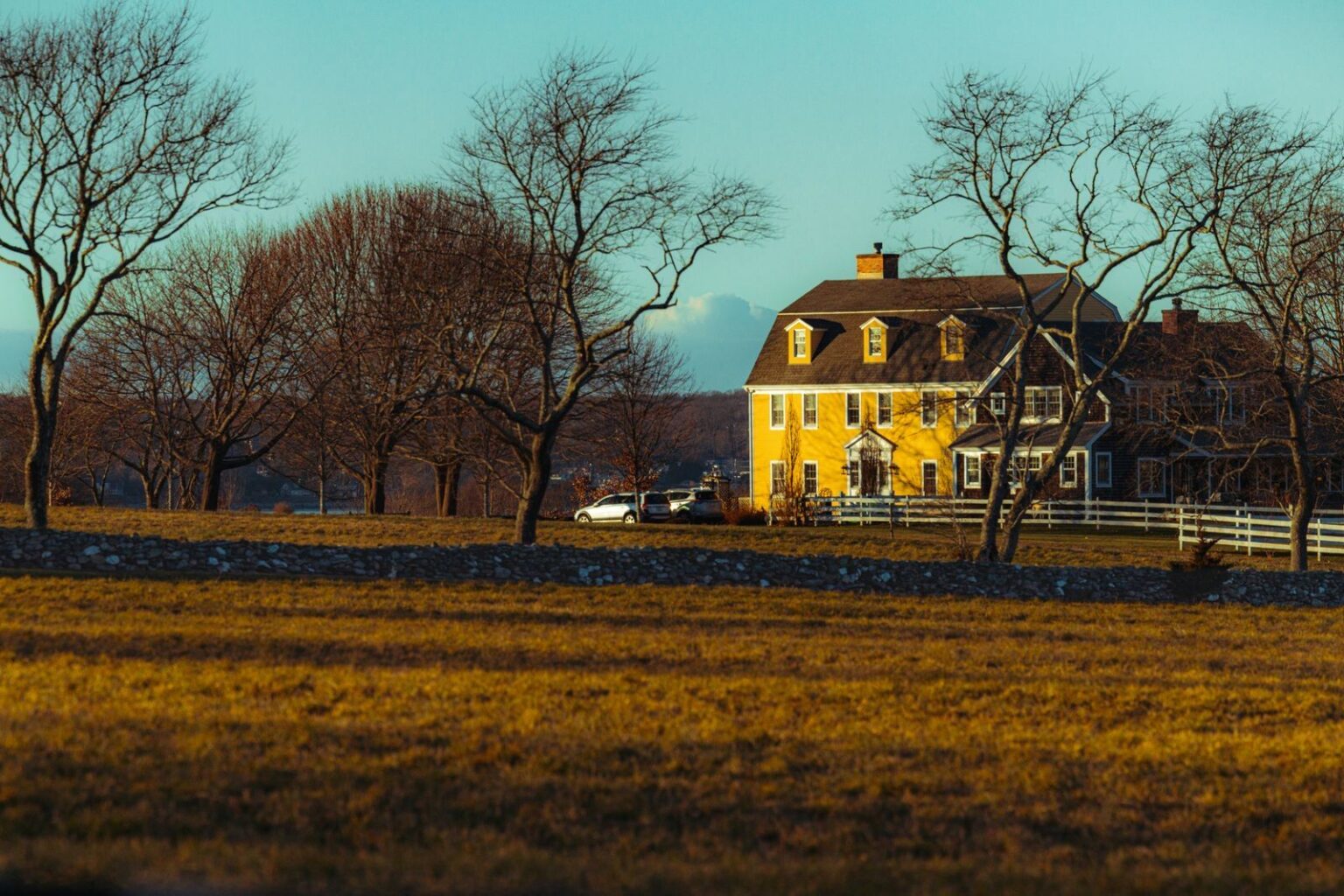
A 19th-century farm in Litchfield County, Connecticut, has become a symbol of how historic home renovation Connecticut and contemporary art collecting intersect today. In the fall of 2023, interior designer Robert Stilin received a message from his friends Cristopher Canizares and Dan Friedman: they had found a farmhouse larger than the one they were living in, of the same style and period, but in need of major work. From that text came one of the most talked-about residential projects of the year, not only for the restored architecture but for what it contains inside.
Key points
- In 2023 designer Robert Stilin led the renovation of a historic farmhouse in Litchfield County, Connecticut.
- The project merged three 19th-century buildings: an 1850s farmhouse, an 1870s schoolhouse, and an 1890s tobacco barn.
- The house hosts works by Isa Genzken, Maia Cruz Palileo, Rashid Johnson, Stanley Whitney, Roni Horn, and Marc Swanson.
- Owner Cristopher Canizares, former partner at Hauser & Wirth, founded the agency Artist Legacy Bureau in May 2026, dedicated to the long-term management of artists’ careers.
Renovation of a historic farmhouse in Litchfield County
The project arose from the very concrete needs of two constantly on-the-move professionals. Canizares, an art agent, and Friedman, a tech executive, lived—or rather, shuttled—between Manhattan, Philadelphia, and a small farmhouse in Connecticut. The goal was to consolidate everything into a single, larger, more welcoming base, able to host family and friends without compromise.
Merging three 19th-century structures into a single home
Friedman describes the property as “a story that has stretched across centuries”: at the center is an 1850s farmhouse, attached to an 1870s schoolhouse and connected, via a closet-like corridor, to an 1890s tobacco barn. Thanks to several successive interventions, including the one by Stilin, today it is almost impossible to see where the three structures have been stitched together. The modest size of two of the original buildings has left a legacy of windows facing one another, naturally capturing light in every room of the house.
The project and the signature of Robert Stilin
Stilin says he accepted enthusiastically, trusting his clients’ sensibility: “I knew they would be relaxed and professional clients. They know what they like, but they don’t have time to deal with it: they have very demanding careers.” The three men met for the first time in the new house that winter and saw each other again when the work was practically finished, communicating mainly through voice messages, emails, and texts while Canizares and Friedman were traveling. The result is what Stilin calls “a country house that’s not too country”: an overtly masculine taste, tempered by a touch of vintage style. Much of the work, the designer explains, consisted in selecting the couple’s extensive furniture collection to adapt it to the rediscovered spaces.
A contemporary art collection that tells the owners’ story
Unlike many of his clients, for whom Stilin also oversees the choice of artworks, here the collection was already a chapter written by the owners themselves. Each room of the restored house thus becomes a small map of Canizares’s taste and professional history in the art world.
The main works and their connection to the owners
In the entrance, the ironically dystopian radio sculpture by Isa Genzken, “Weltempfänger (World Receiver)” from 2015, rests on a Shaker-style chest, beneath an oil portrait by Maia Cruz Palileo. In the beamed dining room, one of the oil paintings from the “Anxious Red” series by Rashid Johnson occupies the main wall: a piece that has particular value for Canizares, because he and Johnson worked together when the art agent was a partner at the artist’s gallery, Hauser & Wirth, and today Johnson is among the clients of Artist Legacy Bureau. This summer the couple joined Johnson in Menorca for the opening of the Residency at Casa Gràcia, a retreat for artists and writers co-founded by the artist with Sheree Hovsepian.
In the living room, an untitled 2020 work by Stanley Whitney sits on the mantelpiece, while the 1997 photographic diptych “Dead Owl” by Roni Horn dominates the space above the sofa. In the far corner stands “Untitled (Golden Crate)”, a 2009 sculpture by Marc Swanson. Canizares jokes that “there’s always the chance to own things that aren’t on display”: a quip that reveals how the collection as a whole exceeds what is actually shown within the walls of the house.
For those looking at the art market, this kind of private collection matters because it makes a broader phenomenon visible: works by artists already represented by leading galleries, such as Johnson and Whitney, continue to circulate in the domestic spaces of the professionals who have followed their careers, helping to strengthen their reputations and, indirectly, their valuations among collectors and institutions.
From Hauser & Wirth to a new model of art agency
The story of the house in Connecticut is intertwined with a significant career change for Canizares, who entered the art world back in high school. After a decade between Matthew Marks and Richard Gray, in 2010 he joined Hauser & Wirth, eventually becoming a partner before leaving the gallery last spring.
Artist Legacy Bureau and long-term management of artistic careers
In May 2026 Canizares founded Artist Legacy Bureau, an agency designed to focus on what he says he had always liked more than any other aspect of his work: the long-term development of artists’ careers. “I’ve always found that working with artists on their long-term growth was the most rewarding part of my job,” he explains, adding that reconciling these conversations with the immediate priorities of a gallery had become almost impossible. Hence the decision, a quarter of a century into his career, to rebalance his priorities.
In recent years several agencies have emerged that look to the business models of film, fashion, and sports to find new revenue streams for artists, from collaborations to sponsorships. Canizares acknowledges that these are useful tools, but his approach remains closer to the orthodoxy with which an artist’s career has traditionally been built: “I think the main job of an artist is to make art. And most of the artists I know want to be in the studio.” The agency therefore focuses on less flashy but essential elements: coordinating international gallery representation, strengthening relationships with institutions, building a publishing program, and defining an artistic legacy plan, which may take the form of a foundation or other solutions.
This is the point that really matters to those operating in the art market: an agency like Artist Legacy Bureau does not broker Hollywood-style deals, but manages an artist’s reputation and continuity over time, elements that directly affect the value of their works and the long-term confidence of collectors and institutions. Canizares himself emphasizes that agencies of this kind open up new possibilities not only for artists but also for galleries, “which have a thousand different things to manage,” offering the art world the chance to embrace a more advanced level of specialization. A vision that, for now, is taking shape right at his kitchen table in Connecticut.
FAQ
Which historic buildings were combined in the renovation of the house in Connecticut?
The renovation combined an 1850s farmhouse, an 1870s schoolhouse, and an 1890s tobacco barn into a single residence.
Who is Cristopher Canizares and what is Artist Legacy Bureau?
Cristopher Canizares is an art agent who founded Artist Legacy Bureau in May 2026, an agency focused on the long-term development of artists’ careers.
Which artworks are present in the renovated house in Connecticut?
The house hosts contemporary works by Isa Genzken, Maia Cruz Palileo, Rashid Johnson, Stanley Whitney, Roni Horn, and Marc Swanson.
How does Artist Legacy Bureau differ from other art agencies?
The agency focuses on coordinating gallery representation, relationships with institutions, a publishing program, and planning artistic legacy, rather than on Hollywood-style dealmaking.
Read also: The renewal of ICA Miami, a contemporary art museum, is supported by a 40-million-dollar campaign · Parliament is examining the law for the restitution of stolen art
Content created with the assistance of artificial intelligence and with human editorial review.


