From hospitality to airports and cruise ships, the tourism sector is increasingly integrating art into the design of the visitor experience, opening up new opportunities for collaboration between businesses and the cultural sector
The fact that culture represents one of the main resources of Italian tourism is well established. According to estimates reported by Federculture, cultural tourism generates more than €56 billion in Italy, accounting for more than half of the sector’s overall economic impact, while almost 60% of foreign visitors choose Italy partly because of its cultural heritage. The annual Impresa Cultura report also shows that, in the approximately 1,000 Italian municipalities with a strong cultural vocation, tourist stays increased by 9.8% between 2019 and 2025, compared with average national growth of 5%.
These figures show how closely cultural heritage, territorial attractiveness and the development of the tourism value chain are interconnected. But they also point to a further evolution: culture does not simply influence the choice of destination. Increasingly, it becomes part of the concrete experience that visitors purchase and live.
It is at this point that the relationship between art and the tourism sector becomes particularly interesting. Artworks, exhibitions and cultural projects can move beyond the places traditionally dedicated to their enjoyment and become part of hotels, resorts, ships and transport infrastructure. For businesses, this means being able to use culture in shaping their offering; for cultural operators, it means engaging with new contexts of production and new audiences.
The question, therefore, is no longer simply how much tourism can benefit from culture, but how art can become part of the design of the tourism offering and what forms of value this integration can generate.
Hospitality as a space for Cultural Production
The relationship between art and hospitality has progressively moved beyond a purely decorative function. This evolution is particularly evident in art hotels, where collections, site-specific commissions, architecture and cultural programmes contribute to shaping the identity of the property and become part of the experience offered to guests.
What is particularly interesting is that this dynamic is not confined to ultra-luxury properties. In Jesolo, Camping Village Waikiki has created the Natural Art Oasis, integrating artworks and nature into the spaces of the resort while involving young artists and students from the Marco Polo Art High School in Venice.
The project shows how the integration of art and tourism can take different forms and also involve local organisations outside established contemporary art circuits. The place of accommodation thus becomes a space where cultural production enters the everyday experience of a holiday.
In the cruise sector, the same approach takes different forms. Explora Journeys, MSC’s luxury brand, has launched a collaboration with Clarendon Fine Art to bring iconic works by renowned modern and contemporary artists onto its ships, alongside activities aimed at engaging passengers and introducing them to collecting. MSC Cruises, meanwhile, has developed The Art Wall, a programme dedicated to artworks and commissions conceived for specific environments aboard its ships.
In these cases, art becomes part of the construction of the offering itself. It is not simply added to an already defined tourism product, but contributes to shaping its identity and differentiating its proposition. Culture thus becomes a point of contact between businesses and professionals operating within the cultural value chain.
When Infrastructure becomes a Destination
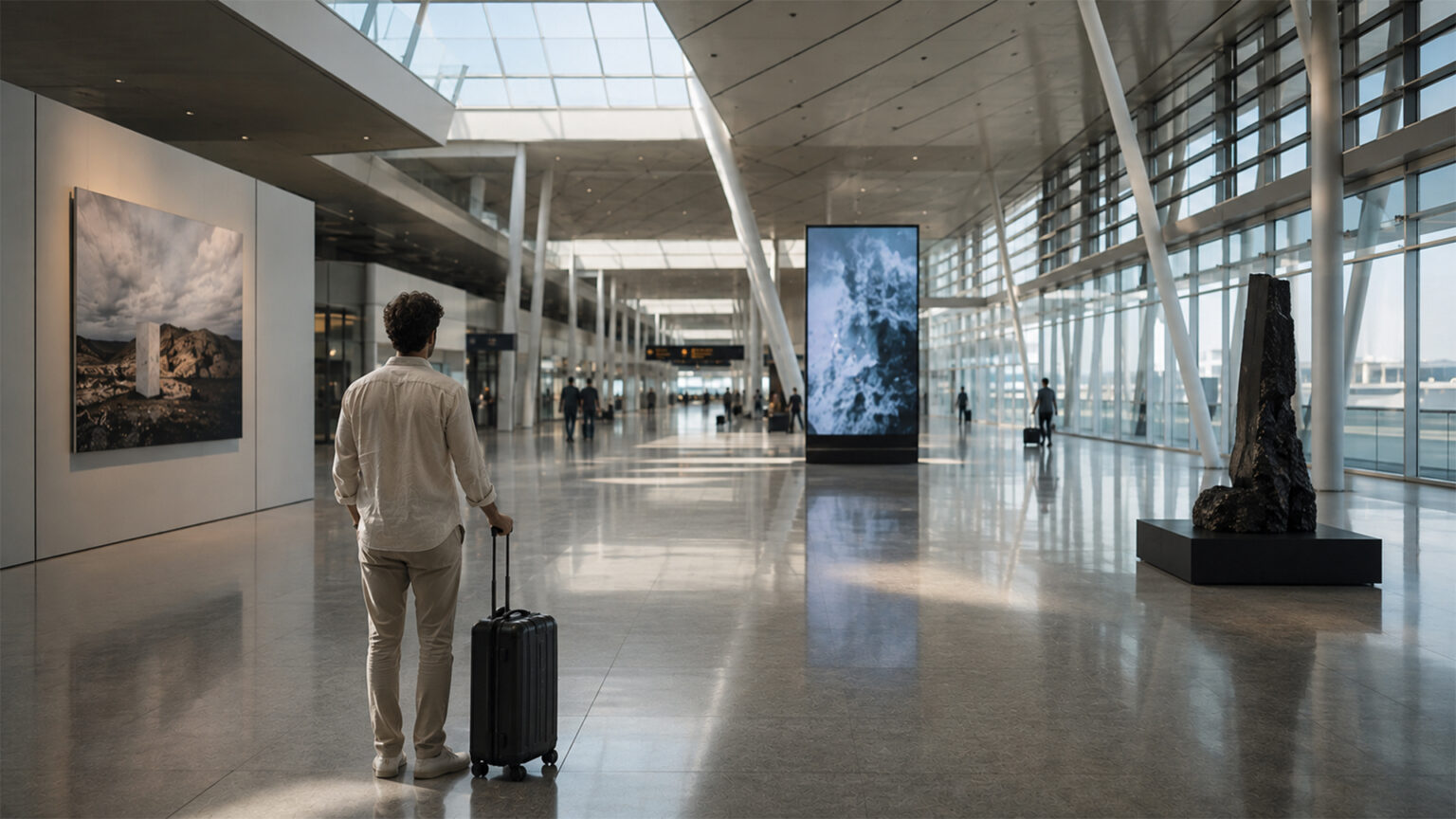
An even more significant development concerns transit spaces. Airports and other infrastructural environments have long been associated with the concept of the “non-place”: impersonal environments primarily designed to facilitate mobility, where individual experience tends to be subordinated to the function of passage.
Art can intervene precisely in this dimension, helping to change the perception of an environment and its relationship with the surrounding territory.
Fiumicino Airport provides a particularly significant example. Aeroporti di Roma has chosen to develop Leonardo da Vinci Airport as a “diffused museum”, with the aim of showcasing Italy’s artistic heritage and creating a more direct relationship between travellers and the culture of their destination.
The presence of works such as Grande Folla N.1 by Giò Pomodoro, together with other exhibition projects, reflects a vision in which the airport is no longer considered exclusively as passenger transport infrastructure. Cultural intervention contributes to creating a recognisable environment capable of anticipating the experience of the destination.
This is also the perspective behind Vision of Roma, a project by Spazio Taverna involving Veronica Pamio, Senior Vice President External Affairs, Sustainability & Destination Management at ADR. The project starts from a precise question: if Fiumicino is the first place where many visitors come into contact with Rome, can the airport become a first cultural experience of the city rather than simply its gateway?
The answer leads to considering art as a means of mediation between infrastructure, destination and visitor. The aesthetic and cultural experience begins before arriving in the city centre, and the airport takes on a role within the territorial narrative.
Malpensa has also developed a similar approach. SEA has used contemporary and digital art to enhance some airport spaces through projects such as Nice to meet you, created in collaboration with Meet Digital Culture Center and curated by Maria Grazia Mattei, as well as initiatives dedicated to photography and illustration.
A new space for collaboration between Business and Culture
The examples of hospitality, cruising and airports belong to different segments of the tourism value chain, but they point to a common trend. The sector is beginning to use culture as a strategic design element, incorporating it into the places and experiences that make up the tourism product.
This shift also has implications for the cultural sector. As art enters new contexts, opportunities for collaboration increase for artists, curators, foundations, archives, associations and third-sector organisations.
The model does not necessarily have to be traditional sponsorship. An accommodation facility can commission a project; an airport can develop an exhibition programme; a shipping company can create a collection or a programme dedicated to art collecting; a tourist resort can support the production of works by young artists.
The difference is substantial. In this type of partnership, the business provides spaces, audiences and opportunities for engagement, while the cultural sector contributes expertise, content and curatorial skills. The relationship can therefore generate benefits for both sides: the business enhances its offering, while cultural operators gain new channels for production, dissemination and access to audiences.
This opens up a professional field in which creative and project development skills must engage with the specific needs, languages and objectives of the travel market. For businesses, collaboration with the art sector can instead become a tool for building identity, reputation and positioning.
From Events to Long-Term Planning
Integrating art into the tourism value chain also raises the question of continuity. A cultural collaboration acquires greater substance when it is coherently embedded in the structure of the offering and maintains a recognisable relationship with the place, the audience and the identity of the business.
For this reason, the objective should not be to turn every hotel into a gallery or every airport into a museum. The more interesting possibility lies in designing, case by case, the role that culture can play within the tourism experience.
This perspective also makes it possible to address the issue of seasonality. A cultural project does not necessarily have to coincide with a summer event or a temporary initiative. When integrated into the structure of the offering, it can help shape a destination over time, create new reasons to visit and extend the cultural experience across a broader period.
For tourism businesses, culture thus becomes a potential driver of differentiation and innovation. For cultural operators, opening up to the tourism sector represents an opportunity to reach new audiences, places and forms of collaboration.
The contribution of art, however, is not limited to its economic dimension. It can concern the quality of the experience, the recognisability of a place, a company’s reputation, the enhancement of a territory and the creation of new professional opportunities. These are different dimensions that can converge within the same project.
The Holiday as a Cultural Experience
Tourists can encounter art before they have even decided to visit a museum or monument. They can do so by entering a hotel, walking through a terminal, waiting for a flight, staying at a campsite or spending a week aboard a ship.
It is this progressive expansion of the places where culture can be experienced that is changing the relationship between art and tourism. Culture is no longer necessarily a supplementary activity to be added to an itinerary, but can be incorporated into the design of the experience itself.
For the tourism value chain, this means considering art as a potential component of the offering and a tool for differentiation. For the cultural sector, it means engaging with a broader market in which businesses and territories can become partners in artistic production.
The holiday thus also becomes a space where culture and business meet. The result is not simply a new way of experiencing art, but a different way of designing the places and experiences of travel: culture can become part of the environment of the holiday itself, helping to shape how it is perceived and remembered.
Read also: Christie’s pop culture division is born after a record of 105 million · Art & Welfare: when companies invest in culture