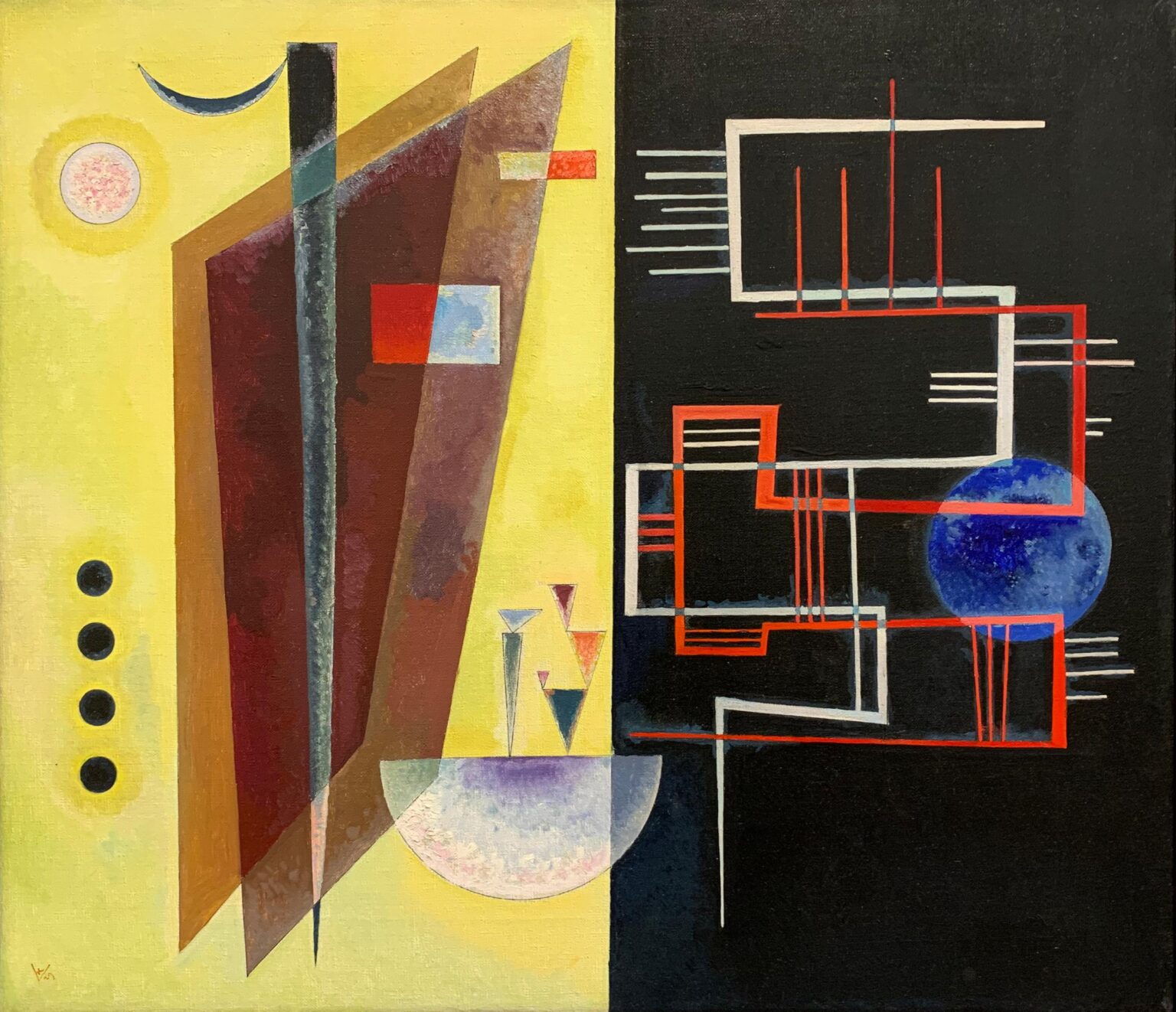
A painting by Wassily Kandinsky was sold for $85.8 million by Christie’s in New York. It is the new auction record for Kandinsky’s Betonte Ecke and for the entire career of the Russian artist.
Key points
- Kandinsky’s Betonte Ecke reached $85.8 million including fees on Tuesday evening at Christie’s in New York.
- The hammer price was $74 million.
- The result surpasses the artist’s previous record, $44.8 million, set in 2023 at Sotheby’s in London.
- The painting, consigned anonymously by the Nahmad family, had been sold for just $1 million in 1986.
- Christie’s guaranteed the sale with an irrevocable bid from a third party.
The auction record for Kandinsky’s Betonte Ecke in New York
The canvas comfortably exceeded the threshold of $85 million. Bidding started at $54 million, already ten million above the artist’s previous record.
The duel between three bidders
Three people competed for the work: Alex Rotter, global president of Christie’s, Sara Friedlander, head of the postwar and contemporary art department for the Americas, and advisor Ralph DeLuca. In the end Rotter won the painting with a winning bid of $74 million, which rose to $85.8 million with fees.
Christie’s guarantee and the Nahmad consignor
Before the sale, the auction house had already guaranteed the work to the sellers by finding a third party willing to cover the risk with an irrevocable bid.
The work came to market anonymously, but its provenance was known to insiders: it belongs to the Nahmad family, a historic dynasty of art dealers. The last time it went to auction was in 1986, when it was sold at Sotheby’s in New York for $1 million.
The history and provenance of the painting
Betonte Ecke, which in German means “Accentuated Corners,” is a painting by Kandinsky.
The years at the Bauhaus in Weimar
Kandinsky painted the square canvas in Weimar, in the early years of his teaching at the Bauhaus, according to Christie’s. The work, dated 1922–1923, translates the idea of a total art—capable of uniting painting and music in an almost spiritual dimension—into geometric forms and repeated patterns.
From the Guggenheim to the Nahmad family
In 1929 the painting was purchased by Hilla Rebay, the first director of the Guggenheim Museum, who donated it to the New York institution in 1941. It remained in the museum’s collections for over twenty years.
In 1964 the Guggenheim decided to deaccession 50 Kandinsky oil paintings, selling them at Sotheby’s: among them was Betonte Ecke itself, which at the time went for just £22,000. From that moment the work changed hands again before reaching the Nahmads.
An $626.6 million evening for Christie’s
The sale of Kandinsky’s canvas was part of a much broader evening: the 20th-century art auction organized by Christie’s at its Rockefeller Center headquarters, which lasted more than two and a half hours. The second most valuable lot of the night was a landscape by Gustav Klimt, which sold for $82.3 million.
The auction house had estimated the sale, consisting of 74 lots, between $511 million and $743 million, after five works were withdrawn before the sale, including a Frida Kahlo painting estimated between $2 million and $3.5 million, removed from the catalog just hours before the start. The total hammer price reached $521.1 million, slightly above the low estimate, for a total including fees of $626.6 million.
Of the 74 lots on offer, 68 found buyers, with a sell-through rate of 92%. Besides Kandinsky, the evening also set new records for Hans Bellmer, Fernando Botero, Wifredo Lam, and Cornelis Cornelisz van Haarlem, while works by Fernand Léger, Henri Matisse, Joan Mitchell, Amedeo Modigliani, Henry Moore, and Jackson Pollock went unsold.
The comparison with the previous year nonetheless tempers the enthusiasm: the equivalent Christie’s sale, which at that time also included the collection of Robert and Patricia Ross Weis, totaled $690 million, making this year’s result about 9% lower.
Content produced with the assistance of artificial intelligence and with human editorial review.