A rare drawing by Michelangelo related to the Sistine Chapel ceiling has set a new auction record, revealing the still unexplored potential of the market for great masters on paper.
How the new record for a Michelangelo drawing at auction was set
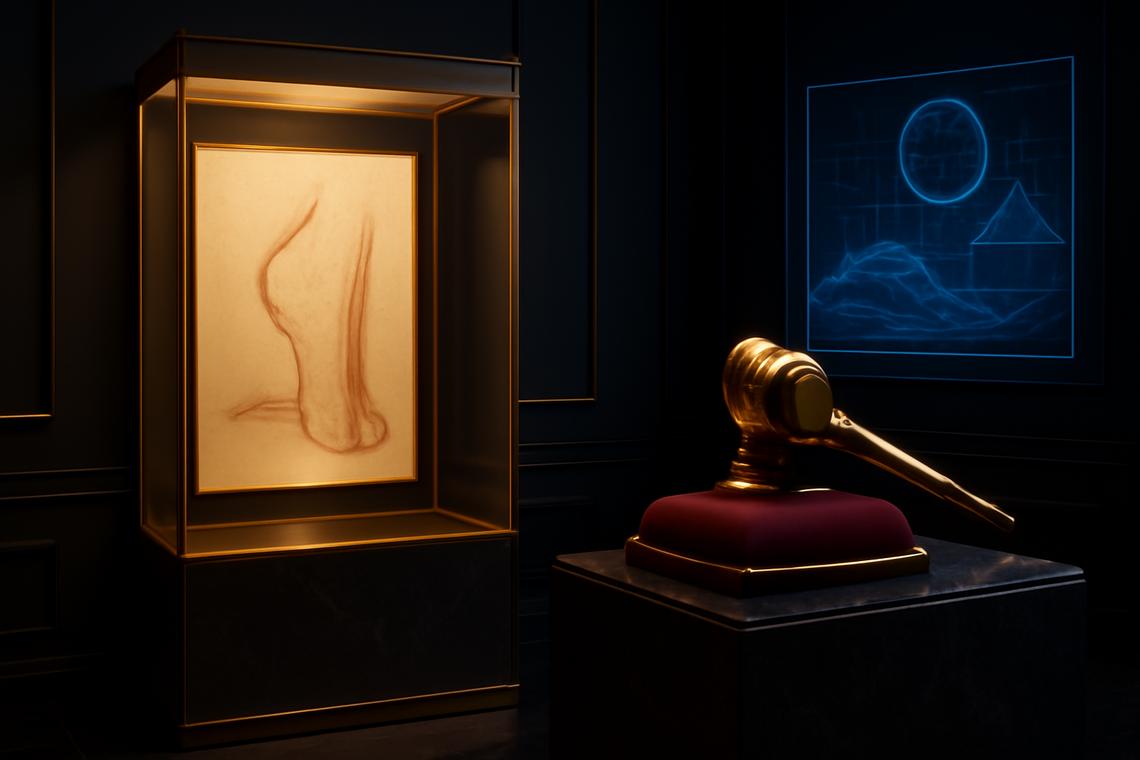
A rare preparatory drawing by Michelangelo Buonarroti, a study for the foot of the Libyan Sibyl frescoed in the Sistine Chapel, was sold by Christie’s in New York for 27.2 million dollars (23.10 million euros). The sale, held in 2024 at the Rockefeller Center, set a new world record for a work by the artist at auction.
The story originated from a simple photograph sent through the auction house’s online portal to request an evaluation. From that request emerged one of the most significant discoveries in recent years in the field of ancient drawing, with an owner unaware of having such an important unpublished sheet in their hands.
After careful analysis, the sheet was recognized as an autograph study by Michelangelo for the Sistine Chapel ceiling. Moreover, the result of 27.2 million dollars exceeded the initial estimate by almost twenty times, set between 1.5 and 2 million dollars (1.3–1.75 million euros), highlighting the strength of demand for museum-quality works with unexpected provenances.
Which record was surpassed and what does it indicate for the market?
With this sale, the previous record for a Michelangelo drawing, also set by Christie’s in Paris in 2022, was broken. On that occasion, another sheet by the artist was sold for 23.162 million euros, equivalent to 24.3 million dollars at the exchange rate of the time.
Compared to the 2022 figure, the new American result marks a further leap forward. Overall, the sale confirms the extreme rarity of autograph sheets by the Florentine master and the growing market interest in high-quality works on paper, especially when accompanied by an unusual discovery story.
These developments fit into a broader context of reevaluation of ancient drawing, as demonstrated by the results of major international auctions dedicated to old masters, where lots with secure attributions and iconic subjects continue to perform beyond expectations.
What does the study for the foot of the Libyan Sibyl represent?
The sheet, titled Study for a Foot of the Libyan Sibyl (circa 1510–1511), is executed in red chalk on paper and measures 135 x 115 millimeters. It is a study of the right foot of the Libyan Sibyl, one of the monumental figures placed on the eastern side of the ceiling, famous for its anatomical rendering and dynamic pose.
The work belongs to the small core of about fifty studies directly connected to the decoration of the Sistine Chapel, commissioned by Pope Julius II and executed between 1508 and 1512. Moreover, it is the only study for the Sistine ceiling ever to appear on the market without known previous ownership, which increases its exceptional nature.
According to scholars, of the approximately six hundred drawings by Michelangelo that have come down to us, only about ten remain in private hands today. In this context, the emergence of a specimen linked to one of the most famous cycles in art history represents an entirely extraordinary event.
How did the auction at Christie’s in New York unfold?
The sale concluded after about forty-five minutes of intense bidding in Christie’s room at the Rockefeller Center. The sheet attracted the interest of collectors present in the room, bidders connected by phone, and online participants, in a competition that made its uniqueness evident.
For many potential buyers, it was likely the only opportunity to acquire a study directly connected to what is often defined as the greatest masterpiece of Western art. That said, the duration and intensity of the bidding also highlighted the solidity of the top segment of the ancient drawings market, less volatile than other sectors.
The lot was finally awarded with a bid presented by Andrew Fletcher, Global Head of Old Masters at Christie’s, who acted on behalf of a client. The dynamics of the auction fit into the tradition of major international evening sales, where competition between institutional and private collectors remains very intense.
Who recognized the hand in Michelangelo’s drawing?
The attribution of the drawing is due to Giada Damen, a specialist in the Old Master Drawings department at Christie’s. She identified, in the sheet sent via photograph, stylistic, technical, and formal characteristics fully consistent with Michelangelo’s hand.
The study shows an almost sculptural attention to the bone and muscular structure of the foot, faithful to the artist’s approach to the human body. Moreover, the intense practice of drawing from life and the deep knowledge of anatomy, also matured through direct study of bodies, clearly emerge in the volumetric construction of the form.
Christie’s, which in recent years has invested in digital platforms for preliminary evaluation of works, was thus able to move from a simple online request to organizing a historic sale. A case that demonstrates how internal curatorial expertise remains decisive even in the era of web-based appraisals.
What were the internal reactions at Christie’s?
Andrew Fletcher, who has worked in the field for over 23 years, emphasized the exceptional nature of the event. In a statement made after the auction, he said that this experience surpassed all other moments dedicated to the great masters he has witnessed throughout his career.
According to Fletcher, it was an extraordinary work accompanied by an equally remarkable story. Moreover, the presence of numerous bidders in the room, on the phone, and online confirmed that a collector would hardly have the opportunity again to acquire a study so closely linked to a work considered by many as the absolute pinnacle of artistic creation.
The executive also expressed pride in the work of Christie’s team, capable of recognizing the true nature of the sheet and guiding it to this outcome. In contrast to the perception of a fully explored market, the case demonstrates how museum-quality works still emerge through non-traditional channels.
What role did technology and digital channels play in the discovery?
The discovery and sale of this Michelangelo study show how digital tools are transforming the ways in which works of exceptional importance emerge. A simple online submission by an owner unaware of the historical and artistic value of their sheet led to the rediscovery of a fundamental piece in the creative process of the Sistine Chapel.
Moreover, the case highlights the growing role of evaluation portals of major auction houses, which allow collectors and private individuals to propose works without intermediary mediation. Similar platforms are now also active with other leading operators, such as Sotheby’s or Phillips, facilitating the emergence of works that have remained in domestic contexts for decades.
Overall, the journey of this small red chalk sheet, from an anonymous photograph to a world record at auction, brings the drawing back to the forefront as an essential tool for understanding the genesis of great pictorial cycles. At the same time, it confirms how the dialogue between technology, specialized expertise, and the global market can still rewrite crucial chapters of art history.