The cars you dreamed of and stuck on your bedroom wall as teenagers are now officially collector’s items. Classic cars from the ’80s–’00s are no longer just used cars: they’ve become a hot segment of the automotive collecting market, capable of moving tens of millions of dollars at international auctions. The latest proof comes from Monterey Car Week, where RM Sotheby’s auctioned a selection of Ferrari, Porsche, Lamborghini and McLaren models produced between the mid-1980s and the early 2000s, confirming that millennial and Gen Z nostalgia has turned into a real economic engine.
Key points
- Cars produced in the ’80s, ’90s and early 2000s are now considered vintage or classic, with rapidly growing demand among younger collectors.
- At RM Sotheby’s Monterey auction (13–15 August), 38 lots out of nearly 200 were cars dated 1985–2005.
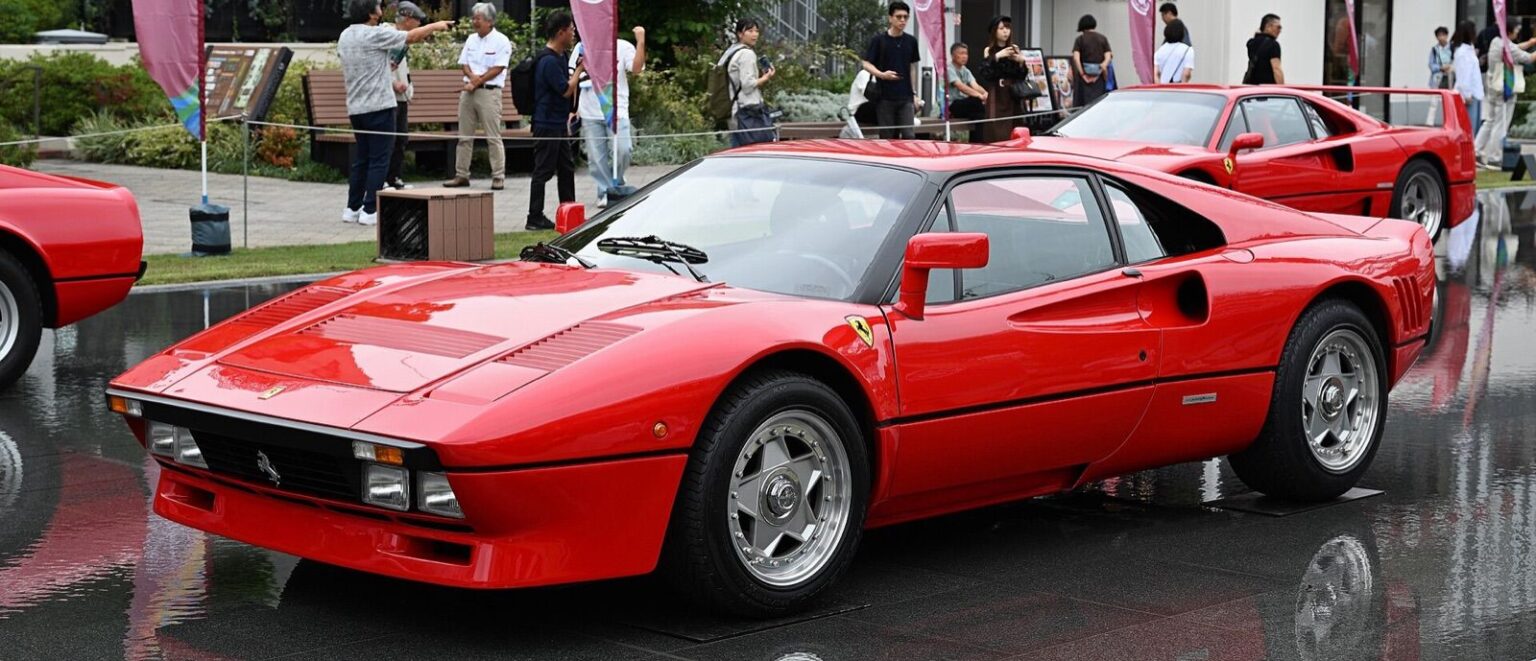
- The Ferrari 288 GTO has seen its value increase by around 1,500% over the last twenty years.
- The 1996 McLaren F1 GTR that belonged to Nick Mason of Pink Floyd, estimated at over 35 million dollars, sold for 34.6 million but was surpassed by the Ferrari Luce EV “Chassis 0”, sold for 40 million dollars in a charity auction.
- Experts such as John Temerian point to the Lamborghini Diablo SE30 and the Mercedes SLR McLaren as models whose growth potential is still largely untapped.
Nostalgia drives growing demand for classic cars from the ’80s to the 2000s
Demand for classic cars from the ’80s–’00s is growing because a generation that grew up with supercar posters on their bedroom walls now wants to drive them again, not just look at them. The phenomenon is reminiscent of vinyl: objects once considered obsolete become cult just as the digital world takes over. Models at every price point, from the Ford Sierra to the Peugeot 205 up to Porsche and Ferrari, have entered the collectible category. A 1997 Volkswagen Golf in original condition is now treated like a legitimate exotic car, simply because so few intact examples remain.
The spread of ‘Millennial Classics’
This new category, which could be called “Millennial Classic”, strikes different chords for each collector: the Golf their mother drove, the yellow Lamborghini Diablo that hung on the wall at age twelve, the silver Lotus Esprit seen in Pretty Woman. Instagram, YouTube, TikTok and online auctions have turned models once considered marginal into objects of desire, fueling demand that the market is absorbing quickly.
Emotional and cultural ties
The appeal of these cars is not just aesthetic. They were born before touchscreens and satnavs: physical buttons offer what many collectors call a “digital detox”. They are also lighter, slimmer and often more agile than their modern successors. Manual gearboxes, suspensions that move perceptibly in corners, unsilenced engines: everything contributes to a direct relationship between driver and machine that, according to collectors, no electric car can replicate.
RM Sotheby’s Monterey auction highlights the vintage car market
The Monterey auction offered the clearest snapshot of how the market is rewarding classic ’90s cars and early 2000s models. Out of nearly 200 total lots, 38 belonged to the 1985–2005 period, a number that alone illustrates the growing weight of this segment in the calendar of major international auctions.
Key moments of the auction
Among the headline models: Ferrari 288 GTO, Testarossa, F40, F50, 360 Modena, 550 Maranello, 575M and Enzo, a Porsche 959 and a Lamborghini Murciélago 40th Anniversary, along with more niche pieces such as the 1999 Vector SRV8 and the 1988 Cizeta-Moroder V16T. The announced star of the sale was the 1996 McLaren F1 GTR in “pop art” livery that belonged to Nick Mason of Pink Floyd, estimated at over 35 million dollars: it ultimately sold for 34.6 million dollars, only to be surpassed by another unexpected car. The Ferrari Luce EV “Chassis 0”, the brand’s first five-seat electric with a combined 1,050-horsepower powertrain, was sold in a charity auction for 40 million dollars, with bids starting at 1 million and climbing to 20 million in a few minutes before closing at a record figure. The proceeds will go to the Ferrari Foundation for educational initiatives. Considering that a new Luce starts at 640,000 dollars at the dealership, the price achieved is more than sixty times the list price. According to estimates, this year’s Monterey Car Week auctions could exceed a combined total of 500 million dollars.
Examples of cars with rising values
The most cited case remains the Ferrari 288 GTO, whose value has risen by around 1,500% over the last twenty years. But the Prancing Horse brand dominates elsewhere too: a 2003 Ferrari Enzo sold for 17.9 million dollars in January, nearly tripling the previous auction record for the model, while another example reached 15.2 million dollars in March. An F40 LM hit 11 million dollars at Monterey last year, and in 2025 a Daytona SP3 was hammered at 26 million dollars, far above its initial estimate of 3.5 million. It’s not an isolated case: nine of the ten most expensive cars sold at auction this year are Ferraris, and five of the top lots at Monterey bear the same badge.
Expert opinions on the market’s future potential
Those who work with collectors every day still see room for growth in some specific segments of the analog vintage car market. The recurring theme is that the value of certain models has not yet reached its peak.
Cars with appreciation potential
John Temerian, co-founder of Curated, a Miami showroom specializing in supercars from this era, points to the Lamborghini Diablo SE30 and GT and the Mercedes SLR McLaren as models set to rise further. “They were built in such small numbers, with so much passion,” he says of the Diablo. On the SLR McLaren, the result of collaboration between Mercedes-Benz, McLaren and designer Gordon Murray, he notes that it should be worth as much as a Porsche Carrera GT or a Ferrari Enzo. For Temerian, the ideal period for reliability and usability runs from 1999 to 2010, when Ferrari introduced the 360 and the 550: well-built, usable cars without the mechanical complications of earlier models.
Collector motivations and market trends
Maurizio de Angelis, a Milanese collector, owns among others two Bugatti EB110 GTs, a Jaguar XJ220, a Diablo GT, a Murciélago LP670-4 SV, a Carrera GT, a Gumpert Apollo, a Bugatti Veyron 16.4 and two Ferrari Testarossas tuned by Koenig. He says he prefers cars with a story to tell rather than the most celebrated models of the moment. Merlin McCormack, founder of Duke of London in Brentford, explains that he has been attached to the Ferrari Testarossa since childhood, when he owned a miniature model of it: “We’re all tired of touch buttons and hybrid supercars that catapult you into license-losing territory before you’ve even felt real emotion.” The picture emerging from the market confirms this view: a younger generation of millennial and Gen Z collectors is gradually replacing the baby boomers, bringing different tastes and, in many cases, treating these cars as investments to flip quickly rather than as vehicles to drive every day.
It remains to be seen how long this nostalgic push can sustain itself, but the Monterey numbers suggest that the market for classic cars linked to the ’80s, ’90s and early 2000s is no longer a niche for a few enthusiasts: it has become one of the most dynamic areas in the entire automotive collecting sector.
FAQ
Why are cars from the ’80s–’00s becoming popular among collectors today?
The trend is driven by nostalgia and by the desire for individuality and for an analog driving experience that modern hybrid and electric cars do not offer.
What role did RM Sotheby’s Monterey auction play in the vintage car market?
The auction offered 38 vintage lots dated 1985–2005 out of nearly 200 total lots, highlighting growing collector demand and the rising value of these models.
Which cars are considered to have the greatest potential for value growth according to experts?
Limited-edition models such as the Lamborghini Diablo SE30 and the Mercedes SLR McLaren are considered likely to appreciate further.
What drives millennial and Gen Z collectors to buy cars from this era?
They seek excitement, emotional connection and an alternative to the lack of character of modern electric and hybrid cars, valuing the driving experience and uniqueness of these vintage models.
Read also: Online auction Capitolium Art records increases in modern art · Phillips increases sales by 10% and approaches the billion dollar mark
Content created with the assistance of artificial intelligence and with human editorial review.