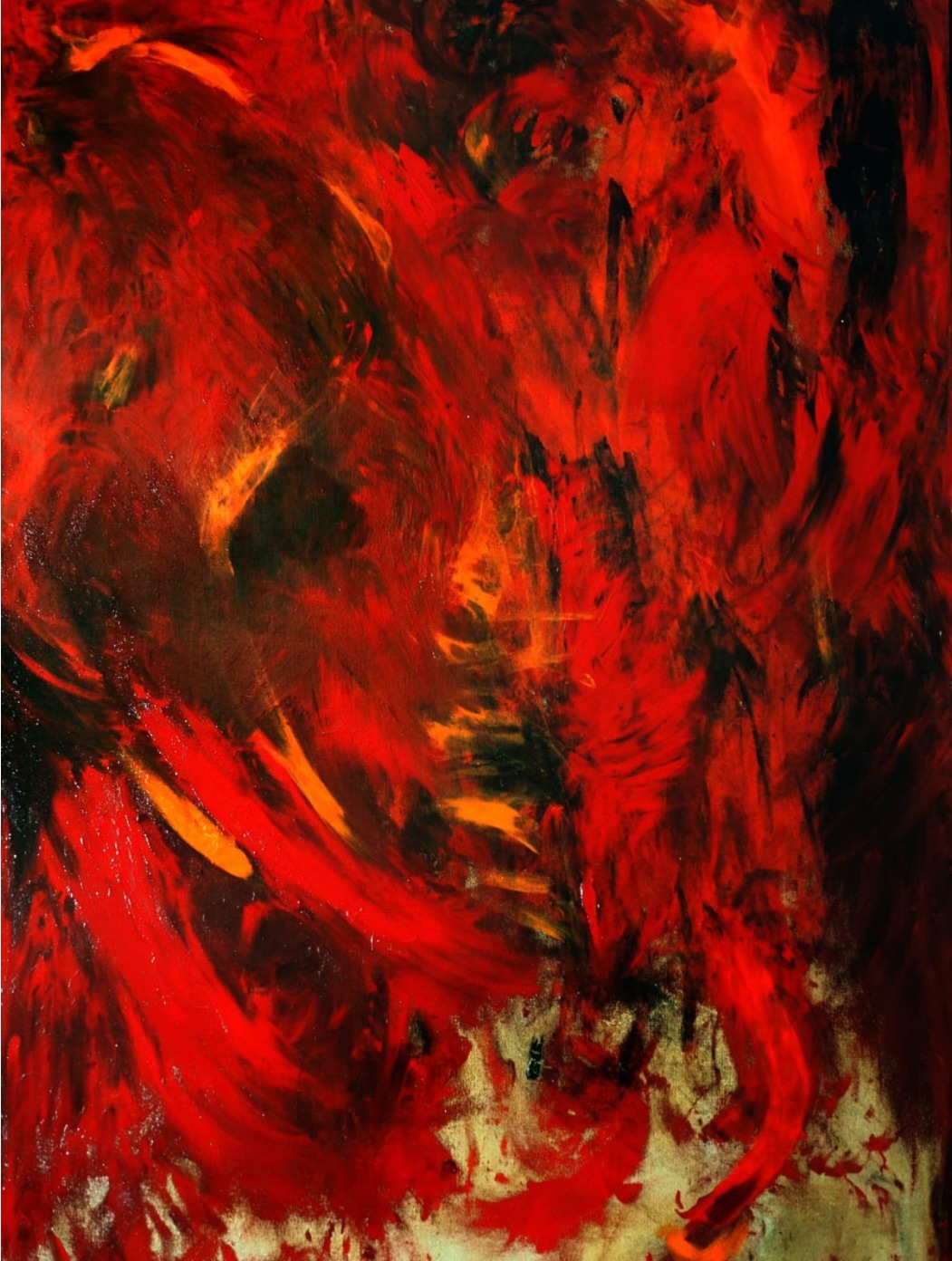
In the instant my gaze landed on a “colored canvas” (named Michael’s Gate), I received an impression that I felt came from the deepest roots of my being.
It was something that resembled a “thrill” that left me surprised and restless. To understand it, I channeled it towards the intellect to which I asked for a rational explanation.
The intellect illuminated and showed me three arcane meanings. The first evoked the “Rorschach” “stains” (a Swiss psychiatrist who devised them in 1921), one of the most iconic and discussed tools of clinical psychology, often described as a “tunnel to the unconscious”.
The basic idea is that, when faced with an ambiguous stimulus lacking an objective meaning, the subject projects onto the blot their own personality traits, internal conflicts, needs, and their own way of perceiving the world.
This would explain why the subjects observing the painting see different things and are deeply affected by it. From this point of view, the Michael’s Gate awakens from the depths of the unconscious dormant images with a hidden meaning.
The other arcane meaning emerges from the shadows of the unconscious to rise to the lofty peaks of religious thought: it is the Ein Sof (the infinite without end) of Jewish mysticism that represents God in His primordial state, before any manifestation or creation. In this state, God is absolutely unknowable, ineffable, and incommunicable, inaccessible to the human mind and “hidden” because He has no attributes that we can comprehend.
The Ein Sof had to “reveal” itself to create the world and make room for finite reality through the 10 Sefirot (emanations).
From this point of view, the Michael’s Gate represents the original unknowable primordial of the civilizations from which the millenary traditions that accompany human thought arise. Among these, there is the “esoteric and initiatory” thought.
We thus arrive at the third arcane interpretation: the esotericism, which is a way of being of myth, religion, and philosophy.
When a man reaches the state of “wisdom” (as the Buddha has admirably described) and acquires knowledge of the external world and of himself, it is a duty towards humanity to transmit it to the “chosen ones” (the capable and eager students who wish to understand it), who are selected through “initiatory trials”.
This establishes a master/student relationship that represents the “flame” that illuminates the darkness of ignorance. The first philosophical schools in India 1500 years B.C. had an esoteric and initiatory foundation, which has followed the human path up to our days.
Freemasonry, the Illuminati, and other Orders have made it the foundation of their existence. Unfortunately, Freemasonry, since the birth of the modern democratic State after the American Revolution of 1783, has irretrievably lost it. A Freemasonry without the esoteric and initiatory foundation is not Freemasonry.
The creation Michael’s Gate, for its psychological, religious, and esoteric nature, is the symbol, the sacred seal, of the rebirth of a true and pure esoteric and initiatory Order for the future of humanity.
Read also: From the “Inscape Rooms” to the Porta della Mente: a cultural dialogue between Swiss research and the vision of Hypnos · The Costume Institute exhibition at the Met changes theme after the Galliano affair