

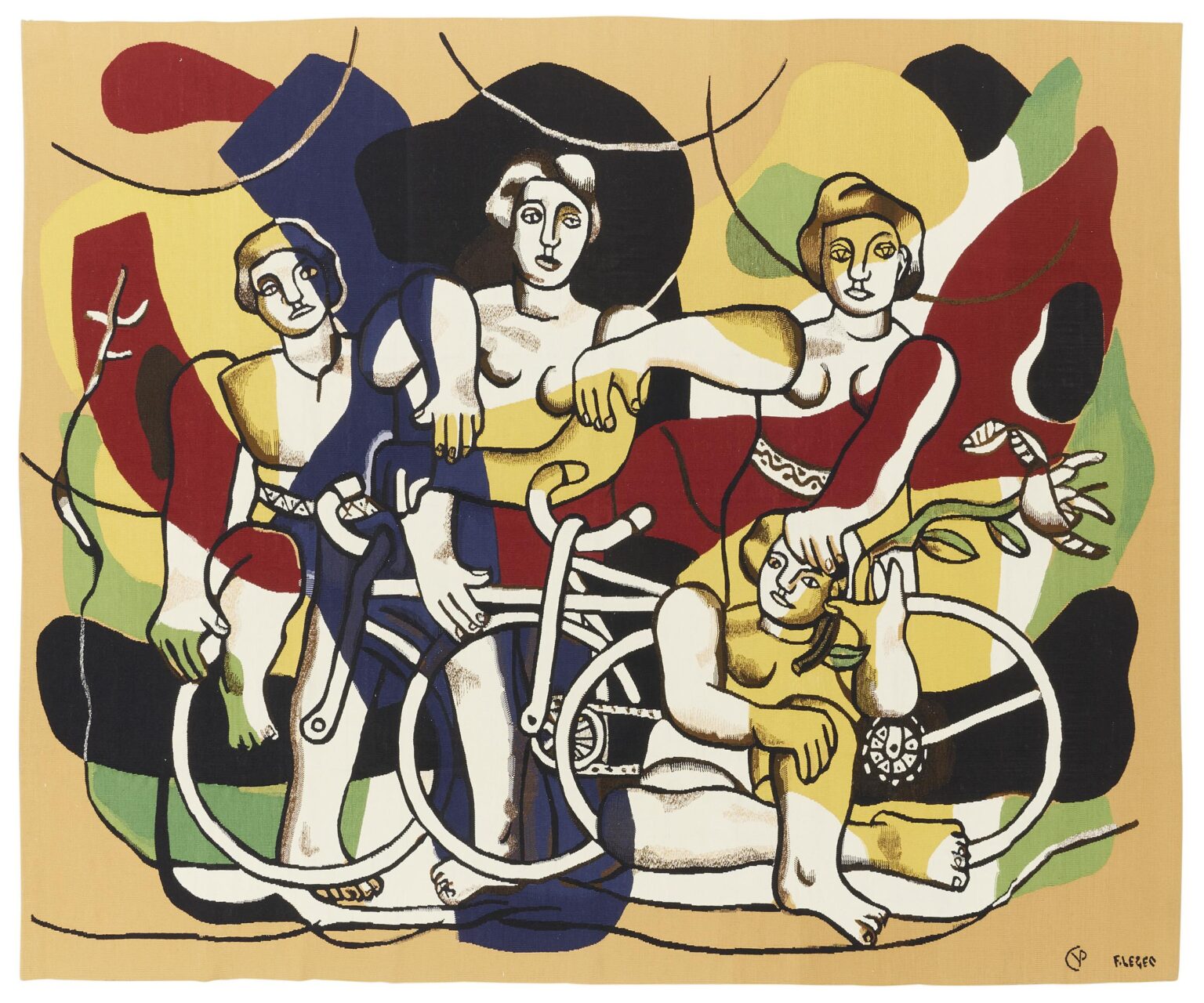
Phillips is opening a textile art exhibition in Milan on 25 November, entitled THREAD/intrecci, dedicated to the relationship between art and fabric in the twentieth century.
Key points
- THREAD/intrecci opens on 25 November in the spaces at Via Lanzone 2 in Milan and can be visited by appointment until 25 January.
- On display are five tapestries by Fernand Léger, Sonia Delaunay, Alexander Calder and Joan Miró, from a private collection in northern Italy, together with six small-format embroideries by Alighiero Boetti.
- The project is led by Margherita Solaini, Regional Director Italy at Phillips.
- Boetti’s embroideries, produced by Afghan and Pakistani makers, have reached a record of 8.8 million dollars at auction.
- The tapestry tradition of Aubusson has been an element of UNESCO’s Intangible Cultural Heritage since 2009.
A textile art exhibition in Milan dedicated to Calder, Boetti and the avant-gardes
A textile art exhibition in Milan brings together works signed by some of the most influential protagonists of the twentieth century. The tapestries by Léger, Delaunay, Calder and Miró, from a private collection in northern Italy, enter into dialogue with six small embroideries by Boetti in a journey that explores the shift from canvas to weave.
The project is overseen by Margherita Solaini, Regional Director Italy and Senior Specialist Modern & Contemporary Art at Phillips. According to Solaini, the exhibition “offers a fascinating perspective on the relationship between art and textiles,” showing how a medium tied to craftsmanship has become “a powerful language of artistic expression.”
The central issue is not only the change of support, from paint to thread. Rather, it concerns what that shift entails in terms of authorship, control and recognition of labour, a theme that runs through the entire selection on display until 25 January.
Roots in the Aubusson tradition and Marie Cuttoli’s programme
To understand why a selection like this is of such interest today to both the market and institutions, we need to go back to 1927. That was when Marie Cuttoli, a French collector and entrepreneur, launched a commissioning programme aimed at the most important names of the modern avant-garde, inviting them to translate their visual language into tapestry.
From 1928 the compositions were produced in the workshops of Aubusson, a town in the Creuse, in central France. Its tapestry tradition has been inscribed since 2009 on the UNESCO list of Intangible Cultural Heritage, a recognition that certifies the historical value of a craft production that is still today a point of reference for those who collect this type of work.
It was not just about turning paintings into tapestries. It was an experiment in cross-contamination between the modernity of the image and a centuries-old manufacturing knowledge, where colour is articulated through thread and line is reassembled in the weave.
The Boetti case: embroideries, auction records and the question of authorship
The most debated chapter of the exhibition concerns Alighiero Boetti, the artist whose weavings have reached an auction record of 8.8 million dollars. His embroideries, entrusted to Afghan and Pakistani makers, make delegation a constitutive element of his poetics.
The artist establishes the system and conceives the image; the material execution is instead entrusted to a community of embroiderers who are bearers of their own cultural tradition. From this arise the questions that weigh on the value of the works: who signs, who executes, who decides, and how much of that collective labour remains visible once the work enters the collecting circuit under the name of its originator.
It is precisely in this gap, between those who conceive and those who execute, that Phillips’ project finds its most interesting point.
A market rediscovering textiles, between specialised fairs and retrospectives
The textile sector has its own mercantile aristocracy, made up of specialists who are anything but improvised. De Wit Fine Tapestries, a Belgian firm present at fairs such as TEFAF and BRAFA, deals in ancient and modern tapestries with an expertise that includes research, conservation and provenance verification.
At the same time, the PAC is hosting the retrospective dedicated to Sheila Hicks, In the Thread of Love, a sign of renewed institutional attention to the expressive possibilities of fibre. Between fairs, auctions and museums, textiles are once again intersecting the contemporary art system, rather than being rediscovered from scratch.
What is presented today as an emerging trend is in fact the continuation of a story that runs through the entire twentieth century. The textile art exhibition in Milan organised by Phillips serves to remind us of this, precisely at a time when, according to primary sources, the market has never stopped recognising its value, and when, in the current reading, textiles appear as a new trend.
Content produced with the assistance of artificial intelligence and with human editorial review.


