

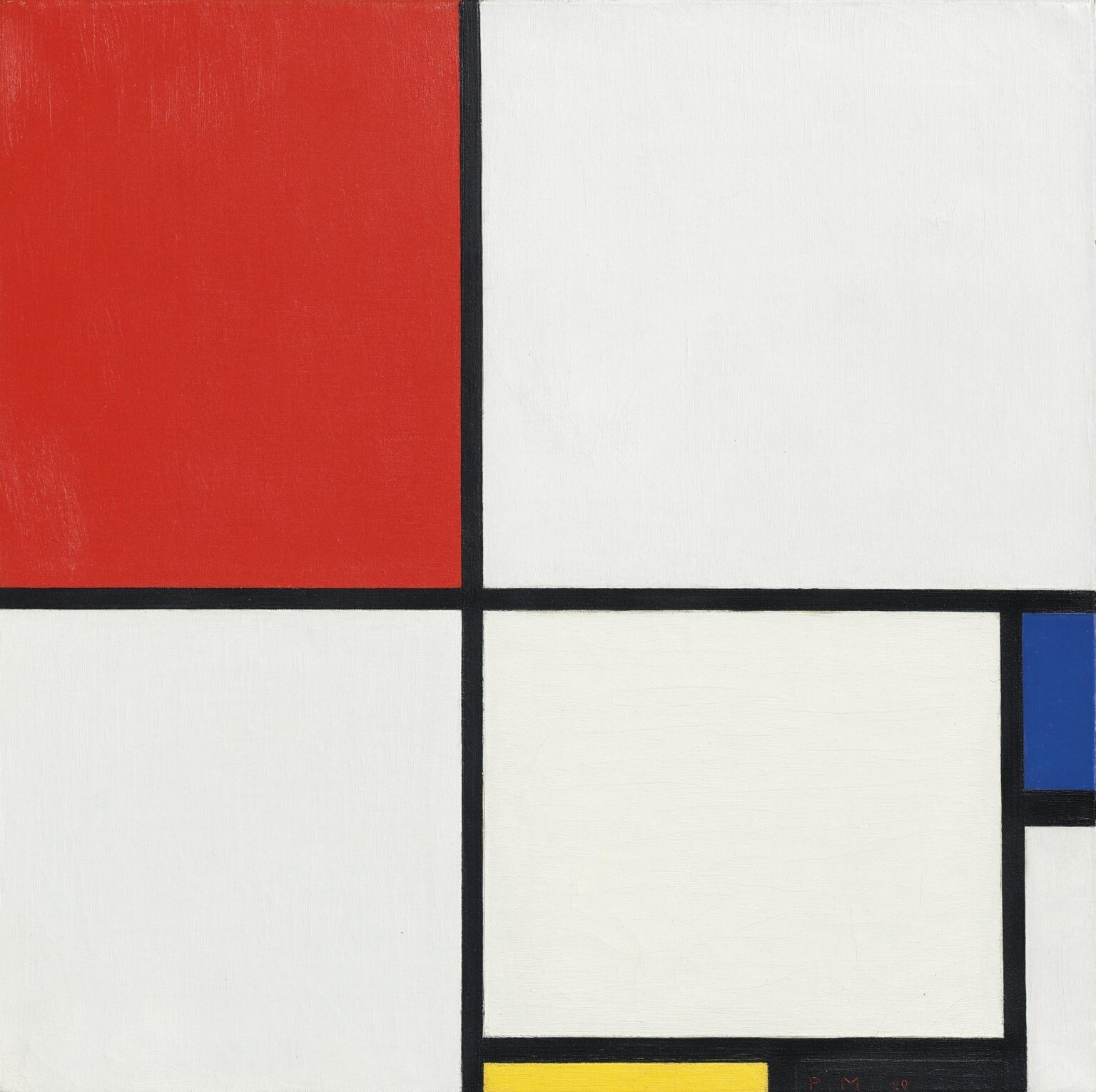
Three masterpieces with a backstory capable of competing with the auction price itself: this is the common thread of the October art auctions that will enliven London and New York. At Christie’s, a Composition III by Piet Mondrian appears that has never been seen on the market, while a Kandinsky confiscated by the Nazis returns to circulation after a legal case that lasted years. In New York, meanwhile, Sotheby’s puts under the hammer a marble torso that could depict a Roman emperor. Three lots, three provenance stories, a single appointment for those who follow the historical art market closely.
Key points
- Mondrian’s Composition III (1920) debuts at Christie’s in London on 14 October with an estimate of £20–30 million, the highest for a Mondrian at auction in Europe since 2009.
- Kandinsky’s Das bunte Leben (1907) returns to the market after being restituted to the Lewenstein heirs in June 2023, with an estimate above $30 million.
- A marble torso believed to be a Roman emperor leads Sotheby’s Magnum Opus sale in New York on 21 October, estimated between $8 and $12 million.
- An Augustan marble head, probably inspired by Livia, is estimated between $2.5 and $3.5 million in the same session.
Mondrian’s Composition III debuts at auction at Christie’s in London
Composition III makes its absolute debut on the market on 14 October, at the London Evening Sale at Christie’s, after having remained out of public view for 25 years. It is one of the few paintings still in private hands among those created in the key year of Mondrian’s artistic turning point, when the artist set out the principles of Neo-Plasticism by reducing forms to pure geometric abstraction.
A rare work from the year of the geometric turning point
In 1920 Mondrian painted only eight major works. Five of these are now in museum collections, including Tate in London, the Museum of Modern Art in New York and the Stedelijk Museum in Amsterdam. Very few examples therefore remain available to private collectors, and this explains why the appearance of Composition III represents an event for the historical art market.
Bartos provenance and record estimate for Europe
The painting previously belonged to the modernist architect and collector Armand P. Bartos and his wife Celeste. Christie’s has set an estimate between £20 and £30 million, the highest ever assigned to a work by Mondrian sold at auction in Europe since 2009. This figure alone shows how works with secure provenance and documented rarity continue to drive the prices of the great masters of the twentieth century.
The restituted Kandinsky returns to the market at Christie’s
Das bunte Leben, painted by Wassily Kandinsky in 1907, re-enters the market in the autumn after a restitution to the heirs of Holocaust victims who had lost the work during the Nazi occupation. The sale, also scheduled by Christie’s in London on 14 October, marks the first auction appearance of the work since it returned to the family’s hands.
From Nazi confiscation to the lawsuit against Bayerische Landesbank
The painting was purchased in 1927 by the Dutch entrepreneur and collector of Jewish origin Emanuel Albert Lewenstein and his wife Hedwig Lewenstein-Weyermann, who had built up a significant collection of modern art. After the German invasion of the Netherlands in 1940, the work, then on loan to the Stedelijk Museum, was removed and sold at auction in October 1940. It ended up in the hands of the collector Salomon B. Slijper and then passed, in 1972, to Bayerische Landesbank, which kept it on long-term loan to the Lenbachhaus in Munich from 1973, where it was on public display for over fifty years. After decades of research into the family collection, the Lewenstein heirs launched a lawsuit against the German bank in 2017, obtaining restitution in June 2023.
The estimate above $30 million
For Das bunte Leben Christie’s indicates an estimate above $30 million. This is a case that carries weight beyond the individual sale result: every restitution of this kind reinforces the principle that wartime provenance remains a central element in the valuation and marketability of modern works, with direct consequences for how auction houses and collectors verify the history of a work before putting it on the market.
Roman sculptures take centre stage at Sotheby’s Magnum Opus sale in New York
In New York, on 21 October, Sotheby‘s opens the evening session of its Magnum Opus sale with a marble torso believed to be the portrait of a Roman emperor, the highlight of an anonymous private collection that includes over 900 works.
The imperial torso: from $7.36 million to a new estimate of up to $12 million
The sculpture, datable to the first half of the first century AD and perhaps attributable to Augustus, Tiberius or Claudius, wears armour decorated with Sol, the Roman sun god, depicted on a chariot flanked by winged Victories: an iconography that conveyed military success and divine favour. The work had already passed through Sotheby’s New York in 2010, when it came to auction with an estimate of $800,000–1.2 million and was sold for $7.36 million including fees. Today the new estimate stands between $8 and $12 million, a sign of how Roman sculptures from the early imperial period remain a solid segment for those investing in historical art.
The Augustan head of Livia and the context of the Magnum Opus collection
The same session features an Augustan marble head, datable between 27 BC and AD 14, thought to be inspired by the face of Livia, wife of Emperor Augustus and a key figure in the first Roman imperial dynasty. The serene expression, soft features and elaborate hairstyle reflect the aesthetic canons and conventions of female portraiture of the time. The estimate is set between $2.5 and $3.5 million. Both sculptures are part of the broader Magnum Opus sale, built around an anonymous private collection of over 900 pieces, a detail that limits the public reconstruction of provenance but does not diminish interest in two lots of this calibre.
FAQ
What makes Mondrian’s Composition III significant at auction?
It is a rare painting from 1920, the year in which Mondrian set out the principles of Neo-Plasticism, kept out of public view for 25 years and estimated between £20 and £30 million by Christie’s in London.
What is the story behind the restitution of Kandinsky’s Das bunte Leben?
The painting belonged to Emanuel and Hedwig Lewenstein, was confiscated during the Nazi occupation and was restituted to the heirs in June 2023 after legal action launched in 2017 against Bayerische Landesbank.
Which Roman sculptures stand out in Sotheby’s October sale?
A marble torso believed to depict a Roman emperor, estimated between $8 and $12 million, and an Augustan marble head probably inspired by Livia, estimated between $2.5 and $3.5 million.
When and where will these October art auctions take place?
The Christie’s sale in London is scheduled for 14 October, while Sotheby’s Magnum Opus sale in New York will be held on 21 October.
Content produced with the assistance of artificial intelligence and with human editorial review.


