A rare masterpiece by René Magritte, kept away from the market for 25 years, debuts at auction in London with an estimate exceeding 10 million euros.
Why is Magritte’s new auction record expected in 2026?
For the 24th edition of the “The Art of the Surreal Evening” sale, Christie’s London will offer Les grâces naturelles, an extraordinary surrealist canvas by René Magritte (1898-1967). The work, kept for 25 years in the same private collection, has been exhibited since 2009 at the Magritte Museum in Brussels and has never appeared on the market.
The estimate is between 6.5 and 9.5 million pounds, equivalent to about 7.5-10.9 million euros, a figure that places it among the key lots of the evening. Additionally, the canvas will be offered alongside important works by Jean Arp, Salvador Dalí, and Leonora Carrington, confirming its curatorial weight within the selection.
What makes “Les grâces naturelles” a decisive work?
“We are delighted to present this exceptional work at our upcoming auction,” said Olivier Camu, vice-president of the Impressionist and Modern Art department at Christie’s. According to Camu, the work occupies a crucial place in Magritte’s creative journey.
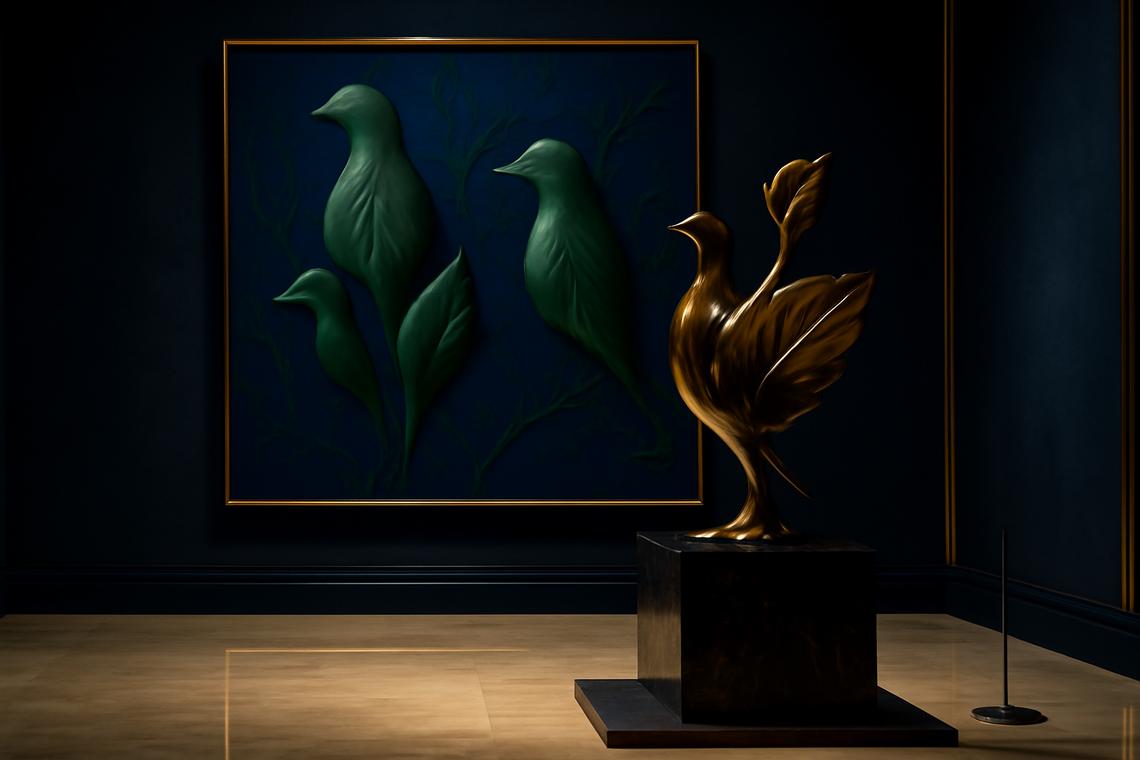
Created in the 1960s, the canvas is striking for its visual construction: on a midnight blue background, crossed by thin branches, emerald green hybrid creatures, half birds and half leaves, emerge in the foreground. However, it is not just a decorative device, but a synthesis of his reflection on metamorphosis.
The painting embodies the artist’s obsession with visible paradoxes that destabilize perception. Magritte revisits one of his most famous motifs, the so-called “leaf-birds,” chimera beings from his fantastic bestiary, caught in the transition between the animal and plant kingdoms.
This transformation remains deliberately incomplete, suspended in an almost ceremonial stillness. Moreover, this very suspension gives the work its strong surrealist dimension, in stark contrast to the apparent simplicity of the subject.
How does the “leaf-birds” motif evolve in Magritte’s career?
Magritte developed this motif in 18 variants throughout his production, testifying both to his personal fascination and the constant demand from collectors. In this sense, Les grâces naturelles represents an advanced and mature stage of the cycle.
The “leaf-birds” first appeared in the early 1940s, in works like L’Île au Trésor (1942), an emblematic work probably inspired by the aviary visible from his home in Brussels. Compared to these early versions, the painting now at auction demonstrates a renewed perspective and greater formal finesse.
Almost twenty years later, the artist revisits the subject with a different approach in Les grâces nouvelles, one of the two largest canvases dedicated to this theme. However, it is in the painting now entrusted to Christie’s that the exploration of perception reaches a particular visual density.
A composition that alters the perception of space
In the compositions of the 1940s, the chimeras stood out against more traditional landscapes. Here, however, Magritte chooses a compact and flat background, saturated with meticulously described foliage, which almost nullifies any spatial reference.
The repetition of the vegetal-animal motif interrupts the sense of depth and gives the whole a quasi-ornamental quality, typical of part of his production in the 1960s. Moreover, this serial structure guides the observer’s gaze in a circular, rather than perspective, movement.
One of the birds spreads its wings, as if suspended between takeoff and stillness. The gesture seems to question the viewer: will the creature manage to emancipate itself from its vegetal nature or remain trapped in this intermediate condition?
Magritte offers no answer, deliberately leaving the enigma open. That said, this unresolved ambiguity contributes significantly to the painting’s allure for the public and collectors.
What is the relationship between painting and sculpture in the “grâces” cycle?
In addition to the canvas version, there is also a three-dimensional version of the “leaf-birds” motif, cast in bronze with the same title in 1967, a few years after the painting’s creation. For this sculpture, Magritte drew on his previous variations on the theme.
The bronze specimen was sold by Christie’s in May 2024 for nearly 3.7 million dollars, setting the world record for a three-dimensional work by the artist. Moreover, this result provides an important economic benchmark for evaluating expectations for the upcoming sale.
With a minimum estimate for Les grâces naturelles approximately double that amount, the final outcome will only be known after the auction on March 5, 2026. Overall, the comparison between bronze and painting highlights how the market recognizes a strong hierarchy of values among the different media in Magritte’s production.
Awaiting the London result, this rare market appearance confirms the Belgian master’s centrality in international collecting and shows how the reinterpretation of his key motifs continues to generate new records and renewed interest.