Present at the fifth New Art Lourmarin, the French artist exhibited six works on the border between painting and sculpture.
He keeps his identity to himself . But the most interesting part starts when you stop trying to figure out what he’s hiding behind the mask.
On October 3rd and 4th 2026, the fifth edition of New Art Lourmarin brought together nearly thirty artists at the Fruitière Numérique, a former agricultural cooperative converted into a “Third-Place” in 2015.
A building whose use has changed. A relevant setting for hosting works that also displace habits and open up new perspectives. Isaac de Honoret was participating for the first time.
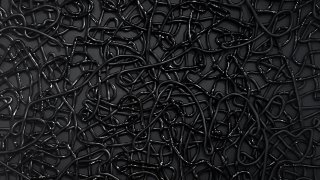
Six pieces, drawn from three collections : Les Connectés, Les Armures, and Les Convergences. On the wall, predominantly monochromatic surfaces take on depth. They fragment, rise up, and set their protruding edges against the light.
The format evokes a painting; the volumes impose a more sculptural interpretation. Light, meanwhile, serves as the connecting thread. It reveals certain reliefs while concealing others, like a narrative whose every detail can never be grasped all at once.
This element of the inaccessible extends even to the artist himself, who cultivates his own discretion.
Identity in the Background, Works in the Foreground
A Frenchman living in Provence, that’s all what Isaac de Honoret agrees to reveal about
his biography.
No age, no background, no legal identity: when he appears in public, it is only behind a mask.
A deliberate withholding of information that goes against a convenient reflex: looking for clues to understanding in the artist’s life. De Honoret deprives us of this shortcut. A biography can shed light on a work of art. It can also assign meaning to it before the viewer has even had time to form an impression.
The encounter shifts. Without being able to connect the forms to a personal story, we must confront what they show us without a safety net.
The viewer has fewer points of reference. But also greater freedom. What we perceive then draws on our own associations, our memories, and our sensitivity to forms.
Synapse: What Happens Through Contact
First piece of the Les Convergences collection unveiled to the public, Synapse brings
together coppery reliefs that touch at the edges.
It’s the shade that gives the composition its unity, where the light shifts the balances. Depending on where one stands, some forms assert themselves, others fade away. The movement of the viewer becomes a component of the work.
It must be experienced to capture what a frontal view leaves out. De Honoret links this collection to the encounters that mark our travels, to the paths that cross or collide.
The title reinforces this idea, since a “synapse” is a point of contact between two nerve cells. In the piece, the forms come together without losing their outlines.
The connection thus takes on a concrete dimension, that of a closeness that exposes us to each other. To others.
Finding the Right Distance
The question of relationships extends into the other two collections presented.
While Les Connectés explores the human distance that persists despite digital connections,
Les Armures focuses instead on the protections each of us builds against the world.
How can we grow closer, and how far should we protect ourselves?
A common ground where the need to open up coexists with the need to preserve ourselves. A coexistence that also sets the tone for our encounter with de Honoret, whose works become familiar to us without our knowing any more about who he is.
Read also: Jensen Huang School of Art: $75 million to replace the college that is closing · ARMAGEDDON: PAINTING AS A BATTLEFIELD OF THE XXI CENTURY