A frozen frame on three shop windows in a city center, visible day and night for almost a month: this is how Enrico Dedin brings his research on the human mind in the digital age into the public space of Mestre. With ATROPHIA the multimedia artist tackles an issue that concerns everyone, from the progressive loss of cognitive abilities to addiction to the immediate stimuli of the web, transforming a theoretical reflection into a visual experience open to anyone passing through Piazzale Candiani. The project continues the common thread of Enrico Dedin multimedia art, which has been intertwining technology, philosophy and social critique for years.
Key points
- ATROPHIA is a site-specific multimedia intervention by Enrico Dedin, part of the Backup project by No Default APS.
- The exhibition is visible 24 hours a day, seven days a week, from October 18 to November 15, 2026 on three shop windows in Piazzale Candiani in Mestre.
- The main works are Melting Thinker, Mirrorphones and Digital Tribalism, accompanied by assemblages made with discarded electronic materials.
- The project includes video contributions by bioethicist Giulia Bovassi and physician Azia Maria Sammartano.
- Backup was created to archive the contemporary memory and identity of the area through art.
ATROPHIA by Enrico Dedin: a multimedia intervention on digital cognition
ATROPHIA stems from a precise premise: the human brain is a plastic organ, capable of evolving or regressing depending on the environment in which it is immersed. Today that environment is a digital infosphere designed to capture attention and foster immediate, polarizing, dopamine-driven reactions. From here begins the digital installation ATROPHIA, conceived by Dedin as a site-specific intervention within the Backup project by No Default APS, in collaboration with Centro Culturale Candiani and M9 – Museum of the 20th Century.
Through installations, videos, images and assemblages, the work focuses on a central contradiction of contemporaneity: we are overwhelmed by data but increasingly less able to interpret it. Physical experience is threatened by its virtual representation, thought by its simulation. According to the artist, the risk does not lie in the use of artificial intelligence in itself, but in the temptation to progressively give up exercising one’s own cognitive faculties: a skill that is not trained tends to atrophy, memory weakens, the attention span narrows, deep thinking loses consistency.
Main works and symbolic assemblages
The three central works displayed in the shop windows, Melting Thinker, Mirrorphones and Digital Tribalism, address the theme from different angles, intertwining philosophical reflection, critique of digital culture and observation of social behaviors. Alongside these, a series of assemblages arises from the reuse of discarded electronic materials: a frame made of microchips houses the surreal image from the photographic series Metamorphosis, while an altered swing replaces the traditional seat with a keyboard hanging from the chains. Disorienting objects that shift the reflection on the relationship between individual and technology onto a symbolic and object-based plane.
Exhibition details and partners in Mestre
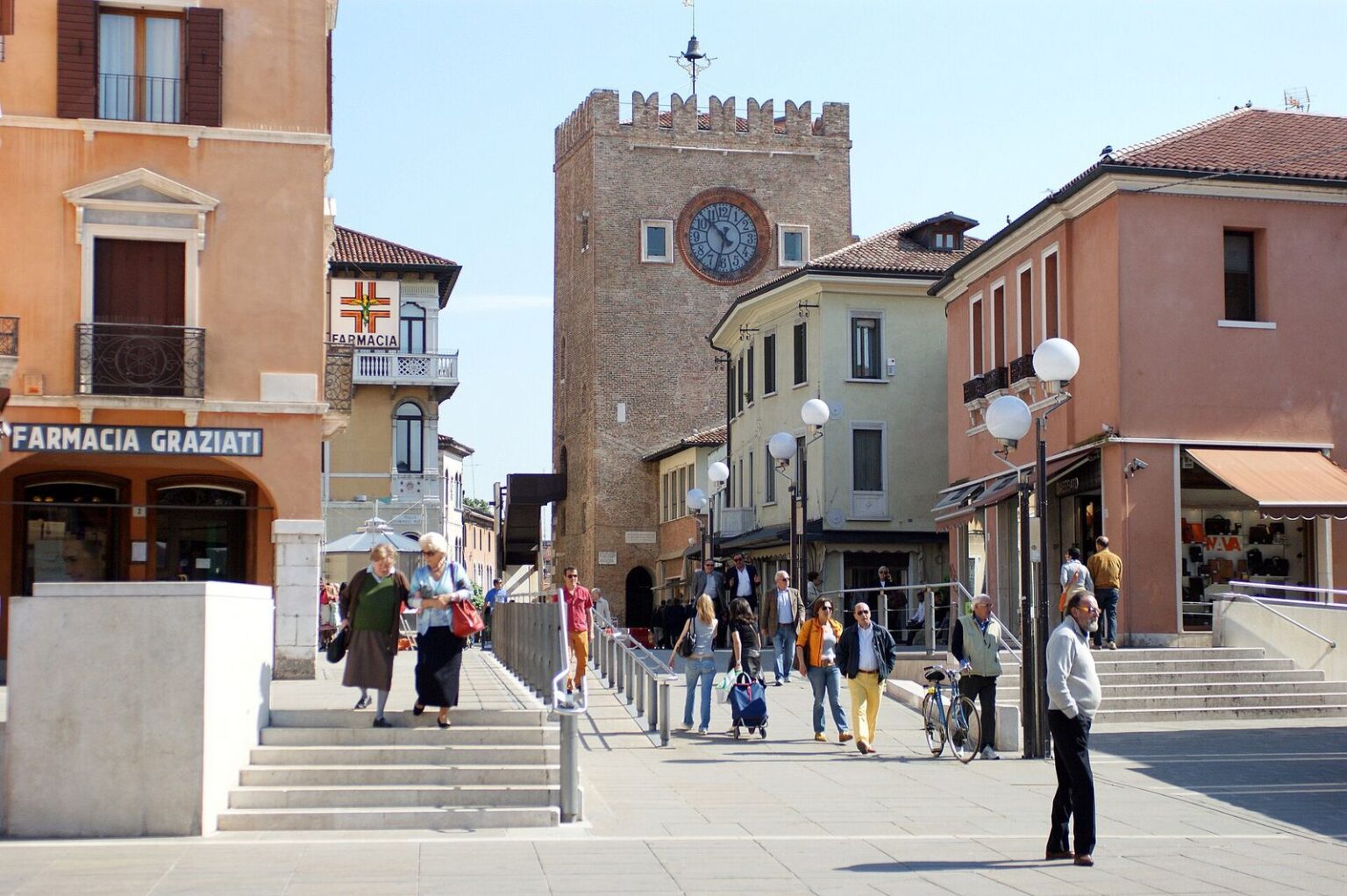
The Backup Mestre exhibition occupies three shop windows overlooking one of the city’s busiest spaces, making the work accessible without a ticket and without opening hours.
Venue, dates and accessibility
ATROPHIA will be visible in the three shop windows in Piazzale Candiani, in the center of Mestre, 24 hours a day, seven days a week, from Sunday, October 18 to Sunday, November 15, 2026. The choice of an open urban space allows direct and continuous access for the public, without the classic mediation of the museum hall.
Context within the Backup Exhibition project
The intervention is part of Backup, the exhibition project by No Default APS created in collaboration with Centro Culturale Candiani and M9 – Museum of the 20th Century. The collaboration between the three entities confirms how the area’s cultural institutions are investing in formats that bring contemporary multimedia art out of traditional halls and directly into public space.
Interdisciplinary involvement and project philosophy
The project does not stop at the exhibition space: Dedin has built a dialogue with expertise outside the art world to broaden the scope of the reflection.
Expert contributions and broadened perspectives
The artist invited Dr. Giulia Bovassi, bioethicist and research fellow at the UNESCO Chair in Bioethics and Human Rights, and Dr. Azia Maria Sammartano, physician specialized in Audiology and Phoniatrics and expert in neurodevelopmental disorders, to participate with a video testimony that will be distributed online in parallel with the exhibition period. Their contributions offer interpretations of the theme of contemporary atrophy from philosophical, psychological and clinical-scientific perspectives, broadening the field of investigation of the intervention and fostering a dialogue between different areas of expertise.
The artist’s vision on art, science and society
This openness reflects a precise conception of the role of culture in society, as Dedin himself explains: “Contemporary art and culture in general should not be considered fields of inquiry separate from reality and from other professional and work spheres. It is necessary to recognize them as active agents, capable of amplifying their impact when they enter into dialogue with sectors that do not strictly belong to the creative sphere.” The dialogue between art, science and other areas of knowledge thus becomes an integral part of the project, in the belief that art’s ability to generate questions and stimulate critical thinking can contribute to broader social awareness. This digital cultural critique by Dedin does not translate into a condemnation of technology, but into the search for a more conscious relationship with the tools that accompany and transform human experience.
Backup Exhibition: archiving contemporary memory and identity
Backup is the exhibition project by No Default APS launched in the winter of 2025 in collaboration with Centro Culturale Candiani and M9, with the aim of archiving the contemporary memory and identities of the area, distinguishing the significant elements of collective culture.
Project goals and activities
Five artists were invited to present site-specific interventions in the three shop windows of Piazzale Candiani; the project also hosted live sets, performances and screenings between the Auditorium of the Centro Culturale Candiani and the spaces of M9. Like a backup copy of the memory of the present, the project aims to preserve traces, experiences and visions of our time, stimulating new reflections and exchanges between the city and artistic research.
Impact on community and culture
The urban space thus becomes the pivot of a shared narrative, capable of generating new stories and connections. After a break of about a year and a half, Backup resumes with its last two exhibitions, reopening an opportunity for encounter and dialogue with the public in Mestre. For those following the evolution of digital art and society as a field of cultural production, projects like this show how much local institutions are focusing on accessible and free interventions to consolidate artistic practices that are still underrepresented in traditional museum circuits, a factor that also weighs on the reputation and future visibility of the artists involved.
Enrico Dedin: artist profile
Enrico Dedin, born in Treviso in 1996, is a media artist and art director based in Fossalta di Piave, in the Metropolitan City of Venice. He graduated with honors in New Technologies of Art from the Academy of Fine Arts in Venice.
Career and international recognition
Since 2013 he has exhibited in Italy and abroad, with participations in The Wrong Biennale, IV Cairotronica, Durrës International Biennale of Contemporary Art, XVI Videoart Yearbook curated by art critic Renato Barilli, and the Collettiva Giovani Artisti of the Bevilacqua La Masa Foundation. His works have also been presented at MAMU in Bogotá, Blue Square in Seoul, MACZUL in Maracaibo, MACA in Alicante and LACDA in Los Angeles. He is featured in the volume L’arte del XXI secolo by Viviana Vannucci and in the Heure Exquise! catalog, the French distributor of audiovisual collections of the Louvre and the Musée d’Orsay. For those who look at the multimedia art market as a field of cultural investment, this kind of presence in international institutional collections and catalogs represents one of the most solid indicators for assessing the trajectory and curatorial credibility of an artist still at the beginning of his career.
Research and artistic approach
ATROPHIA is part of Dedin’s artistic research, aimed at investigating the psychophysical and socio-anthropological transformations of the technological era. His work moves at the intersection of the human, the artificial and the natural, using interdisciplinary languages and visual devices to question the contemporary condition. From this perspective, the work does not merely represent the effects of technology, but questions its logic and consequences, inviting a critical awareness of one’s relationship with the tools that structure everyday life.
FAQ
What is the main theme addressed by ATROPHIA?
ATROPHIA explores the impact of the digital age on human cognition, brain plasticity and the social effects of digital culture.
Where and when can the ATROPHIA exhibition be seen?
The exhibition is visible 24 hours a day, seven days a week, on three shop windows in Piazzale Candiani, in Mestre, from October 18 to November 15, 2026.
Who contributes specialist perspectives to the ATROPHIA project?
Bioethicist Giulia Bovassi and physician Azia Maria Sammartano participate with video testimonies that broaden the project’s interdisciplinary dialogue.
What is the goal of the Backup exhibition project that includes ATROPHIA?
Backup aims to archive the contemporary memory and identities of the area through site-specific artistic interventions that foster cultural reflection.
Read also: Generation Z art collecting trends drive the market in 2026 · Artificial intelligence in the art market: Christie’s sells 20 works above estimate
Content created with the assistance of artificial intelligence and with human editorial review.