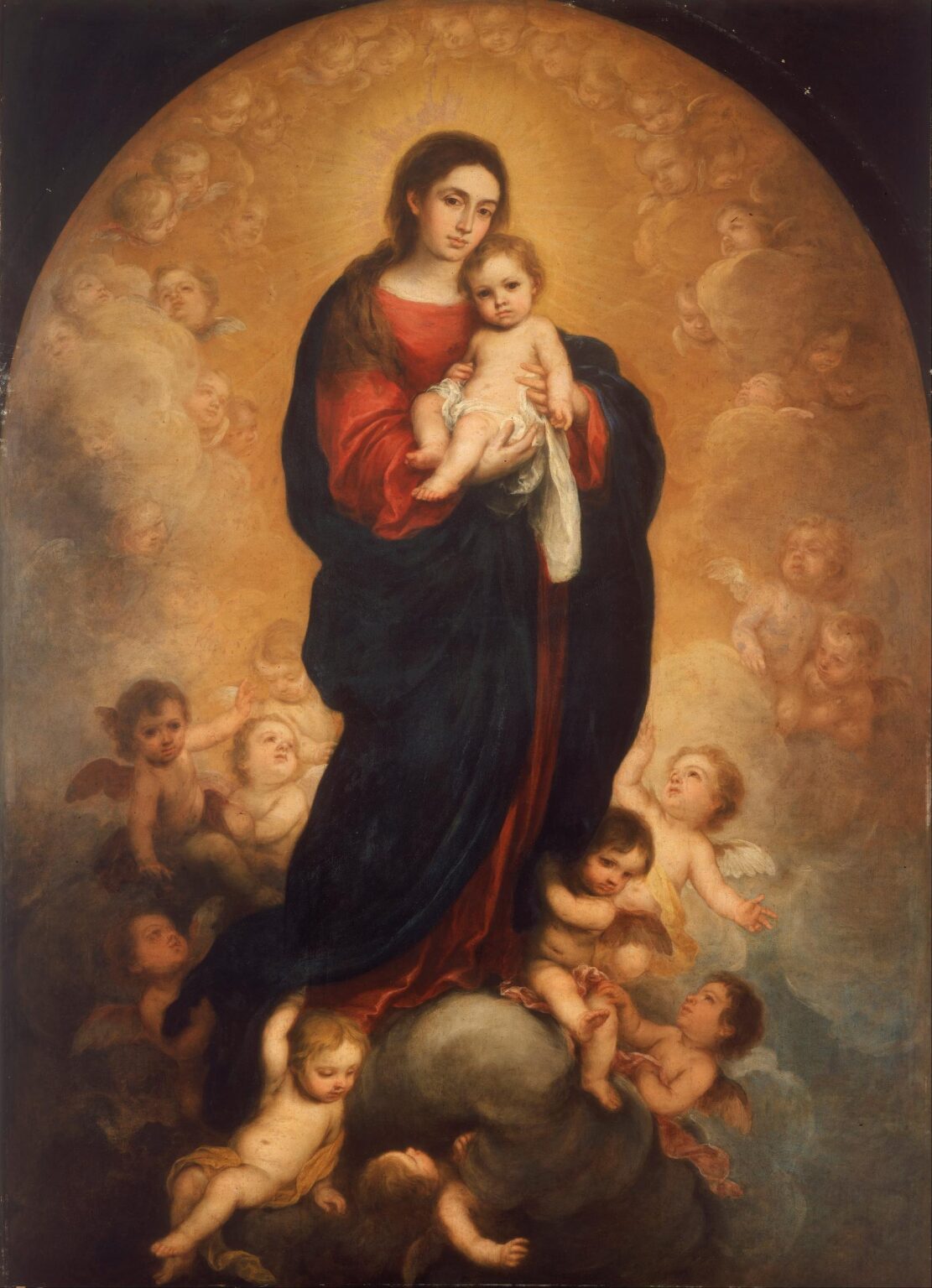
A small painting on obsidian attributed to Murillo reached €286,000 at auction in Vienna, starting from an estimate of just €5,000. The sale took place on 11 November at the auction house Im Kinsky.
Key points
- The painting, a Madonna and Child measuring 30.5 by 25 centimetres, was sold in Vienna by Im Kinsky for €286,000 against an initial estimate of €5,000.
- Scholar Pablo Hereza hypothesizes that it is an autograph work by Bartolomé Esteban Murillo, and not merely by his circle.
- It would be the fourth known painting by Murillo on obsidian, after the works held at the Museum of Fine Arts in Houston and at the Louvre.
- Its provenance links it to the Robert Walpole collection of 1752 and then to the Hermitage, acquired by Catherine II around 1779.
- Considered lost after the Second World War, it reappeared in Vienna with overpainting visible to the naked eye, which may explain the low auction estimate.
Auction for Murillo’s painting on obsidian
A Madonna and Child attributed to Murillo’s circle is not a rarity on the market. But the one auctioned on 11 November in Vienna has a particular feature that changes everything: it is painted on obsidian, a dark volcanic stone very rarely used by the Sevillian master.
Im Kinsky had put it up for sale with an estimate of just €5,000. The painting, measuring 30.5 by 25 centimetres, would have gone unnoticed if it had not been spotted by collectors and dealers from all over the world, who drove it up to €286,000.
Attribution: from Murillo’s circle to the hypothesis of an autograph work
The final price already tells the story: behind the generic label, according to an expert, there may be a possible autograph painting by Murillo on obsidian.
Murillo used obsidian as a pictorial support only on very rare occasions. Today, only three other works on this stone by him are known: one at the Museum of Fine Arts in Houston, and the other two at the Louvre.
If the attribution were confirmed, the Madonna sold in Vienna would become the fourth known work on this support, alongside the Agony in the Garden and Christ at the Column with Saint Peter, both at the Louvre.
Pablo Hereza suggests the hand of the Sevillian master
The scholar Pablo Hereza published his hypothesis on X on the very day of the auction, arguing that the work is indeed by Murillo. According to his reconstruction, reported by ARS Magazine, the painting sold by Im Kinsky corresponds to the one recorded in the collection of Robert Walpole, first Earl of Orford, inventoried in 1752.
The painting had been given to Walpole by Benjamin Keene, the British ambassador to Spain. The measurements reported in the inventories of the time, 30.4 by 24.3 centimetres, almost exactly match those of the work sold at auction.
A provenance that spans England and Imperial Russia
The history of the painting spans almost three centuries and three countries, from Georgian England to the Russia of the tsars and on to Vienna. A trajectory that explains why the work captured the attention of international experts.
From the Walpole collection to Catherine II’s Hermitage
Around 1779 the Walpole collection was purchased by Empress Catherine II for the Hermitage in Saint Petersburg, and with it also the small Madonna on stone. About fifty years later the work was transferred to Gatchina Palace and, after the Second World War, to Pavlovsk Palace, both near Saint Petersburg.
Disappeared after the war, reappeared in Vienna
At a certain point all trace of it was lost, and it was thought to have been destroyed during the conflict. Its reappearance in Vienna, according to the reconstruction by ARS Magazine, instead suggests that it was stolen or sold during the Soviet era.
The work was not entirely unknown to scholars: it was mentioned by Charles B. Curtis in 1883, by Diego Angulo in 1981, by Lyudmila Kagané in 1995 and by William B. Jordan in 2002. For decades, however, no one had seen it in person.
Probable restoration and significance for the art market
Today Murillo’s painting on obsidian appears in a condition that is difficult to read, with overpainting visible to the naked eye. This may explain the caution of the catalogue and the initially low estimate set by Im Kinsky.
A restoration should remove later additions and reveal the original surface painted by Murillo. It is almost certain that the work will be restored and then presented to the public, probably at an art fair next year.
For the Old Masters market, the case shows how valuable a reattribution can be: an estimate of €5,000 turned into a result of €286,000 in the space of a single auction.
If Hereza’s identification is accepted by scholars, the catalogue of the Sevillian painter will regain a work that was believed lost and, moreover, a rare one: Murillo’s fourth documented painting on obsidian, after decades spent in the pages of specialist literature without anyone having seen it again.
Read also: The Hilma af Klint work at Bukowskis carries an estimate of up to €720,000 · Art auction at Van Ham offers a masterpiece with an estimate of up to €500,000
Content produced with the assistance of artificial intelligence and with human editorial review.