

Artprice’s analysis of Art Basel 2026 in Paris reveals a market turnover still oriented towards historical works, while contemporary artists face a more selective auction landscape.
Paris Art Week, held from 19 to 25 October 2026 alongside Art Basel Paris, brought together collectors, galleries and art professionals from around the world.
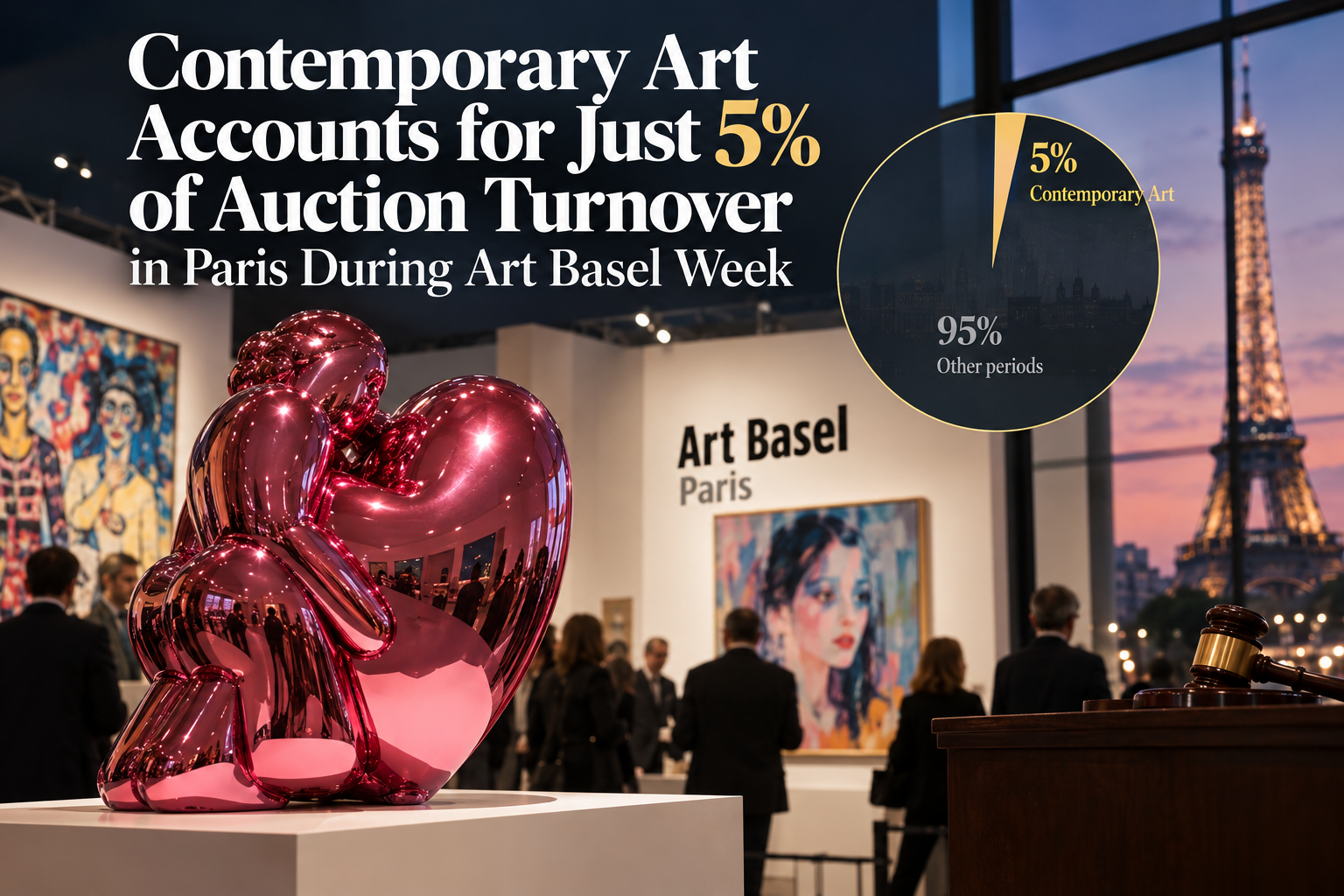
Yet, despite the international attention surrounding the French capital, auction results revealed a striking imbalance: contemporary art accounted for just 5% of total auction turnover in Paris during the week.
According to Artprice’s initial assessment, the results point to a market in which historical works continue to dominate, leaving contemporary artists with a comparatively limited share of auction activity.
The figures also raise questions about the position of French artists in the international art market and why some of the most prominent names in contemporary art achieve greater visibility in New York, London or Hong Kong than at home.
A Market Still Focused on the Past
The results of Paris Art Week 2026 highlight the enduring strength of historical art in the French auction market. Contemporary art, as defined by Artprice for this analysis as works by artists born after 1945, generated $15.8 million from 227 lots sold.
Although no auctions dedicated exclusively to contemporary art were held in Paris during the week, the average price per lot reached approximately $69,600. The figure suggests that demand for contemporary works remains present, even as the overall segment represents a relatively small proportion of auction turnover.
The limited number of high-value results, however, illustrates the selective nature of the market. Only Claire Tabouret and Robert Combas surpassed the €50,000 threshold among French artists during the period covered by the analysis.
For collectors, galleries and artists, the question is not simply whether contemporary art is selling, but where demand is concentrated and which artists are managing to attract international buyers.
Why Are French Contemporary Artists Looking Abroad?
The disparity between Paris and other international art centres raises a broader question about the relationship between artistic reputation and auction performance.
Artists such as Julie Curtiss and Pol Taburet have attracted attention in international markets, including New York, London and Hong Kong. Meanwhile, works by established contemporary figures such as Pierre Huyghe and Laure Prouvost appear relatively infrequently at auction.
This does not necessarily indicate a lack of interest in their work. Auction supply, the availability of significant pieces, collectors’ decisions to sell and the strategies of galleries can all influence the number of works that reach the secondary market.
Nevertheless, the results underline the importance of international networks in shaping contemporary artists’ commercial visibility.
An artist’s market can develop through gallery representation, institutional exhibitions, major art fairs and relationships with collectors across several cities. Auction results in any one location capture only part of that picture.
As Kader Attia discussed in a recent interview with Artprice, the relationship between artistic practice and the structures of the art market remains an important part of understanding how contemporary art is valued and circulated.
Jeff Koons Leads the Week’s Major Contemporary Results
One of the most significant results of the week came from Jeff Koons. An artist’s proof of Ode to Love (2010–2017), from the prestigious Antonio Homem Sonnabend collection, achieved approximately $3.5 million.
The result stood out as the most impressive auction performance in Paris during the period for an artist born after 1945, according to Artprice’s classification. It also demonstrated how exceptional works by internationally established artists can command prices far above the average for the contemporary segment.
Koons’s result contrasts with the more modest outcomes recorded for other artists, illustrating the concentration of auction value around a relatively small number of internationally recognised names.
Robert Combas and the Challenge of Resale Value
The results also highlighted the risks associated with the resale market.
Robert Combas’s Le monde entier (1984), acquired for €110,600 at Christie’s in Paris in 2017, was recently resold at Artcurial for approximately $89,200.
According to Artprice, the work experienced a decline of around 23% in value when comparing the two transactions, with the analysis also taking into account currency movements. The euro had weakened by approximately 8% against the US dollar since 2017, complicating a direct comparison between the original purchase price and the subsequent sale.
The case illustrates why auction prices should not be interpreted in isolation. Currency fluctuations, transaction dates, market conditions and the characteristics of individual works all affect the outcome for collectors.
More broadly, the resale performance of a single artwork cannot establish the trajectory of an artist’s entire market. It does, however, demonstrate that recognition and previous auction success do not guarantee an increase in value over time.
Ben Sledsens Signals Continued Interest in Younger Artists
A different picture emerged with Belgian painter Ben Sledsens, born in 1991. His painting From The Forest To The Sea (2022) sold at Phillips for approximately $202,000.
At just 35, Sledsens achieved the strongest auction result in Paris in four years for an ultra-contemporary artist, according to Artprice.
His performance offers a counterpoint to the overall weakness of contemporary art’s share of Paris auction turnover. While the broader market remains concentrated, individual artists can still attract significant demand.
Such results also highlight the distinction between the contemporary market as a whole and the fortunes of particular artists. Strong prices for selected names can coexist with limited turnover across the wider segment.
What Paris Art Week Reveals About the Global Art Market
The results of Paris Art Week 2026 suggest that the French capital’s auction market remains more oriented towards older works than towards contemporary production. However, the figures should be understood within their specific context: the analysis covers auction sales during a single week, and no exclusively contemporary auctions took place in Paris during that period.
The findings therefore do not provide a complete picture of contemporary art sales across galleries, private transactions, art fairs or institutional markets. Nor do they establish that Paris lacks demand for contemporary art.
Instead, they offer a snapshot of how auction turnover was distributed during one of the international art calendar’s most closely watched weeks.
For contemporary artists, galleries and collectors, the central challenge remains the same: translating artistic recognition into sustained demand across markets. International exposure can create opportunities, but auction performance depends on a combination of reputation, collector confidence, available works and broader economic conditions.
As Paris continues to strengthen its position as an international art destination, the relationship between its cultural influence and its contemporary auction market will remain worth watching.


